Welcome & Course Overview
The MSc in Education degree is a one year full-time degree which aims to provide a grounding in educational research methods and theoretical and methodological understanding of the field of education through one of the following five specialist pathways.
Scholarships
Clarendon Scholarships
The very strongest applicants for all our MSc programmes who apply by the course’s January application deadline are automatically considered for University Clarendon scholarships. There is no separate application process. These are highly competitive and each year only one or two of our students are successful. During our initial admissions screening, supervisors nominate applicants with outstanding academic records to be considered. They then prepare a supporting statement. The Admissions tutor puts forward a shortlist of the strongest applicants to the divisional committee.
Mastercard Foundation AfOx Scholarships
Up to 70 Mastercard Foundation AfOx Scholarships are available each year for applicants to any full-time one-year taught master’s who are African nationals, are ordinarily resident in African countries who are applying and intending to return to Africa upon completion of their studies.
The Mastercard Foundation AfOx Scholarships cover course fees and a grant for living costs for full-time students at the UKRI minimum doctoral stipend rate. Awards are made for the full duration of your fee liability for the agreed course.
To be considered for this scholarship, submit your application for graduate study by the relevant December/January deadline for your course, and tick the relevant box on the graduate application form. If you are eligible for this scholarship, you will be contacted by email in late March and asked to submit additional material to show how you meet the selection criteria.
In awarding the Scholarships the panel looks at four areas: 1) Academic merit and potential 2) Leadership experience and capacity development 3) Alignment with AfOx values and themes 4) Commitment to Africa’s development.
For more information about these scholarships, visit the Mastercard Foundation AfOx Scholarships page.
Oxford-Weidenfeld and Hoffmann Scholarships and Leadership Programme
MSc Education (Comparative and International Education), MSc Education (Digital and Social Change) and MSc Education (Higher Education) applicants who meet the eligibility criteria are encouraged to apply for the Oxford-Weidenfeld and Hoffmann Scholarships and Leadership Programme. In order to be considered for this scholarship, you must select the Weidenfeld-Hoffmann Scholarships and Leadership Programme in the University of Oxford Scholarships section of the University’s graduate application form and submit your application for graduate study by the January application deadline for your course.
The WHT scholarship is for students from emerging economies including Africa, India and China as well as those who have been displaced due to conflict in their home countries.
Oxford Pershing Square Graduate Scholarship
The 1+1 programme is a unique, two-year postgraduate experience which offers you the opportunity to combine the depth of our specialised, one-year MSc in Education with the breadth of Saïd Business School’s top-ranking, one-year MBA. As a result, you will embark from Oxford with the skills to translate specific domain knowledge into practical and innovative solutions to the many challenges facing our 21st century world.
In addition, the Oxford Pershing Square Graduate Scholarship is available for up to five extraordinary 1+1 students who are committed to addressing world-scale social challenges. The Scholarship provides full funding for tuition, college fees and living expenses for both the MSc and MBA year. Please see further details about the Oxford Pershing Square Graduate Scholarship here.
FirstRand FNB Fund Oxford Education Scholarship
When funding is available, the scholarship will provide full funding for a South African citizen to study a one year full-time MSc in Education or MSc in Applied Linguistics and Second Language Acquisition at the Department of Education. The scholarship will be awarded based on academic excellence, leadership ability, community involvement and the candidate’s potential to be a destiny changer. The successful candidate will be a member of Wadham College. Candidates need to apply by the January application deadline for their course.
Further information about the FirstRand FNB Fund Oxford Education scholarship can be found here.
Economic and Social Research Council (ESRC)
This scholarship is available to applicants for the MSc in Education (Research Design and Methodology) who wish to be considered for an ESRC 1+3 studentship. Applicants should signal in their application their intention to continue to doctoral study.
The ESRC is the UK’s largest organisation for funding research on social and economic issues. The University, in collaboration with Brunel University and the Open University, hosts the Grand Union Doctoral Training Partnership – one of 14 Doctoral Training Partnerships accredited by the ESRC as part of a Doctoral Training Network.
In order to be considered for a Grand Union DTP ESRC studentship, you must select ‘ESRC Grand Union DTP Studentships in Social Sciences’ in the University of Oxford scholarships section of the University’s graduate application form. You must also complete a Grand Union DTP Application Form and upload it, together with your graduate application form, by the January application deadline for your course.
Information about ESRC studentships at Oxford can be found here. Please ensure you have read all of the guidance available on the website before you complete the Grand Union DTP Application Form. Please direct your queries to the Grand Union DTP Office at granduniondtp@socsci.ox.ac.uk.
Routledge Scholarship
Each year a Routledge Scholarship of £6,000 is awarded to one student taking the MSc course in Comparative and International Education. Given in collaboration with St Edmund Hall, the scholarship is awarded on the basis of: (1) strength of academic qualifications; (2) fit between the proposed research project and the research interests of the Department and (3) financial need.
All those who apply by the March deadline are automatically considered – no separate application is necessary. The Routledge Scholarship cannot be used as evidence of funding to secure a place on the course.
FAQs
How many students do you recruit to each programme?
The following number of places are available for each of the programme’s pathways:
MSc Education (Research Design and Methodology) – 15
MSc Education (Research Design and Methodology, part-time) – 2
MSc Education (Child Development and Education) – 18
MSc Education (Comparative and International Education) – 18
MSc Education (Higher Education) – 15
MSc Education (Digital and Social Change) – 16
Can I study online or through distance learning?
It is not possible to study at a distance or on-line on our MSc in Education programme.
What are the backgrounds of students recruited to your programmes?
The Department offers a very wide range of courses. As well as a comprehensive Doctoral programme attracting students from all over the world, we offer full-time one year MSc in Education and in MSc Applied Linguistics and Second Language Acquisition (ALSLA) courses, as well as a range of part-time courses, some aimed primarily at active teachers (e.g. MSc Learning & Teaching, MS Teacher Education) and some at distance learning (e.g., Applied Linguistics and Language Teaching). Consequently our courses cater to students from a diverse range of backgrounds.
For example in 2021/22, the Department had a total complement of 780 students of whom 414 were studying full-time and 366 were studying part-time. For 2021/22, across the MSc Education, MSc ALSLA, and DPhil programmes, approximately 29% of our students came from the UK, and the remaining 71% from the EU or overseas. The cohort from those programmes included students from Afghanistan, Australia, Japan, Germany, India, Malaysia, China, Mexico, Estonia, Australia, Russia, South Africa, South Korea, Turkey and the United States, among many others.
What our students share is exceptional academic achievement in their previous learning and an ambition to excel academically.
Can I study part time?
Part-time study is possible on the MSc in Education (Research Design and Methodology).
How much will it cost to study and live in Oxford?
To find out how much it will cost to undertake your studies at the University, please visit the Fees and Living Costs webpage for details.
Can I apply for more than one course?
Yes, however we would strongly encourage you to focus your application on the course for which you have the most interest and experience.
Can I apply for your courses if I am in the process of achieving my qualification to gain entry onto the programme?
Yes, you may apply for any of our courses whilst studying for another degree. If you are successful in achieving a place on one of our programmes, we would make a conditional offer which would include the condition of you achieving your qualification. You are required to submit an interim transcript at application. However, your final outcome would need to be available prior to you commencing the course at Oxford.
English is not my first language; which higher level language qualification is acceptable? And what score do you require?
If you do not have English as your first language, we would like you to have achieved the higher level competence in English Language proficiency. A list of standardised English language tests accepted by the University can be found here. Your test must have been taken no more than two years before the start date of your course. We encourage applicants to apply with a successful language test however if evidence that you successfully meet the English language requirements cannot be provided with your application your application will still be considered as long as all other required documents have been submitted. Any offer of a place will require you to submit English language test results at the required level by a deadline set in the offer letter. Further information can be found by visiting the Application Guide.
Can I apply for a waiver of proof of proficiency in English?
For information on applying for a waiver of the English test requirement please visit the Application Guide.
Should I declare a college preference in my application?
Find here guidance about colleges and making an open application.
How do I apply?
For a more detailed explanation of the process, please click here for the application guide.
Not all of my qualifications will fit on the application form, what shall I do?
If you require more space on the application form, please contact Graduate Admissions for advice.
What should I do if there is not enough space on the application form?
Please contact Graduate Admissions for advice.
I have been outside of an academic setting for some time now; who shall I have to act as my referees?
One of your references should be from your most recent academic tutor. If you are currently in employment, you would be expected to provide a reference from your employer alongside academic references which comment on your academic suitability for the course.
What do I need to include in my ‘Personal Statement’ (‘Statement of Purpose’)?
Further information can be found in the “how to apply” section of the relevant course page.
What do I need to include for the samples of written work?
Further information can be found in the “how to apply” section of the relevant course page.
How is my supervisor decided?
Your supervisor will be decided by the Department following your successful offer of a place on the course on the basis of staff research interests and staff workload and availability.
Am I required to attend for interview?
Candidates will be shortlisted based on academic ability, potential and fit of interests with the course content. Interviews for shortlisted candidates are normally held 2-6 weeks after the closing date of the admissions round. You will be given advance notice of your interview date and time and we require confirmation of attendance.
All interviews will be held online via Microsoft Teams.
What will the interview be like?
The interviews are normally conducted by two interviewers on Microsoft Teams, and will focus on your academic background. You may be asked to outline your research interests and how these might be developed during the dissertation element of the course. You may also be asked about your reasons for wanting to study in this area and the reasons why this particular course is of interest to you.
When will the outcome of my application be known?
Applications will be considered by the admissions panel within the Department and decisions will be made in accordance with the following deadlines:
Application submitted in January will receive a decision by mid March
Applications submitted in March will receive a decision by early April
You will be informed of our decision by email to ensure that you receive the outcome as soon as possible.
In the event that we are not able to offer you a place, we regret that it is not possible to provide you with feedback on your application.
Can I defer entry to a course?
The University will only consider requests for deferral of entry due to exceptional unforeseen circumstances, and only after all conditions set for the offer (both academic and financial) have been met.
Contact
Couldn’t find your answers under our FAQ section?
Please direct any queries or questions to a member of the administrative team and they will be happy to assist you.
Phone: +44 (0)1865 274183
Email: msc.education@education.ox.ac.uk
-
Comparative & International Education
The MSc Education (Comparative and International Education) is a full-time, one-year, Master’s course that engages students in developing a critical understanding of theoretical approaches, methods, policies and practices in comparative and international education. The course aims to develop students’ understanding of the factors that shape educational systems in different parts of the world and the research skills to compare policy choices and critically evaluate major debates, policies, histories and practices of education globally.
Many alumni of MSc Education (Comparative and International Education) course have gone on to academic and research careers at universities in the UK and abroad. Others are employed across a wide range of other sectors such as policy for government departments, NGOs or think tanks, international organisations, administration at local and national levels, as well as state and non-state schools in different parts of the world.
Aims of the course
The course aims to engage students in developing:
- the knowledge, skills and understanding of social, economic, political, cultural, and institutional factors that shape educational systems in different parts of the world
- the ability to analyse current issues and historical trends in comparative and international education;
- the ability to critically assess the historical development and theoretical and methodological underpinnings of comparative and international education;
- the ability to define and formulate research problems and questions in the field of comparative and international education;
- the research skills to undertake contextualised, nuanced examination of policies, practices and systems of education globally.
By the end of the course students should have:
- an understanding of the historical development and theoretical and methodological underpinnings of comparative and international education
- the knowledge of major theoretical and methodological approaches used in comparative and international education and the ability to apply these to current issues
- developed familiarity with the education systems of a number of countries and the ability to describe and analyse those systems critically, with due regard of social, economic, political, cultural, and institutional factors;
- the ability to define and formulate research problems and questions in the field of comparative and international education and the research skills to examine policies, practices and systems of education developed detailed knowledge of major issues affecting education at all levels and be familiar with the work of the various non-governmental agencies concerned with educational planning, research and development.
The course consists of six papers and a dissertation. Students undertake five compulsory modules. For 2023/2024, these compulsory modules are:
- Comparative and International Education: An Overview of the Field
- Foundations of Educational Research I: Concepts and Design
- Systems Thinking in Comparative and International Education
- Foundations of Educational Research II: Strategies and Methods
- The Implementation of the Rights of Children
Students may also choose one option from a list of option papers. The following list provides an indication of papers usually available (please note, this is not a guarantee of availability for any particular elective in a given year):
- Intermediate Quantitative Research
- Perspectives and Debates in Qualitative Research
- Global Higher Education
- Education, the Internet & Society
- Core Principles in Child Assessment
- Critical Digital Innovation
These papers are taken during Michaelmas and Hilary Terms. In Trinity Term, students work on a research-based dissertation, reporting on an empirical study, of 15,000-20,000 (max.) words. The dissertations should demonstrate the students’ research and critical analysis skills as well as the ability to write clear and concise reports to a high level of academic competence.
Seminars during the course are a combination of tutor and student input, and are based on preparation, response to a presentation and/or analysis of documents and various group activities. There is a programme of visiting speakers from around the world.
Examples of recent dissertations
- Thomas Brotherhood Japanese Student Perspectives on Spatial Inequality During Transition to High School
- Naseemah Mohamed Education in a Time of War: The Experiences of Victims of Gukurahundi in Zimbabwe.
- Charleen Ning Chiong Unstable Boundaries: Analyzing Change in Citizenship Education Policy in England (1984-2014)
- Danijel Cuturic Academic Integrity at Universities in Bosnia and Herzegovina: Plagiarism Regulations
- Elodie Broady Opening a Black Box of Influence in the Transnational Governance of Education: a Case Study Inside the OECD
- Rone McFarlane Mediating the Effects of Gang Violence and Related Activities in South African Schools
- Kathleen Maffei Cultural Advocacy Strategies Amongst Parents of Intellectually Disabled Children in UK Schools
- Morten Hansen A Way forward for EEPS: Interrogating and Consolidating Theories on the European Education Policy Space
During their time in Oxford, course members will be part of a lively research community with interests in a wide range of topics in comparative and international education. The University of Oxford provides an ideal environment for graduate study: its resources are first-class and its graduate population is among the best qualified in the world. The Department of Education is a particularly friendly institution within the University, and the international constitution of the student body makes everyone feel at home.
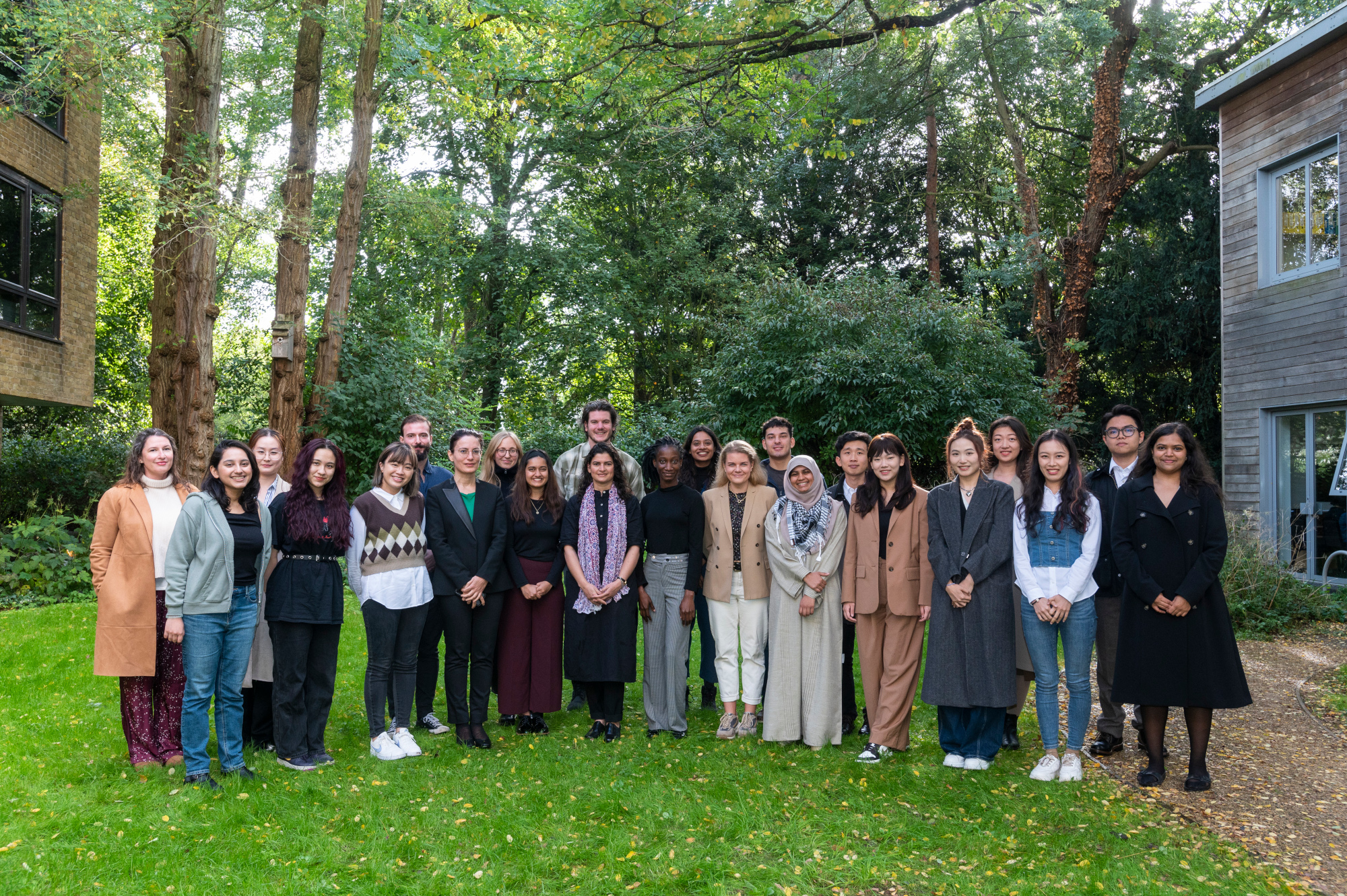
MSc CIE pathway 2023 cohort
-
Child Development & Education
The MSc Education (Child Development and Education) aims to promote a critical understanding of theories and research on child development and their relevance to the design and evaluation of educational programmes and policies in diverse contexts. It also aims to promote a critical understanding of the current challenges for a global and inclusive science of child development.
Our students come from varied professional backgrounds: experienced Early Years professionals and primary school teachers; professionals working with children and aiming to prepare themselves for a leadership role (e.g. head teachers, professionals engaged in programme evaluation research, including in governmental and non-governmental agencies). We welcome graduates with psychology degrees who wish to develop their knowledge of psychology in the field of child development and education; those seeking to pursue a doctoral degree will find that this course offers them a solid disciplinary and research foundation.
This is a full-time, one-year Master’s course.
Aims of the course
- To promote a critical understanding of theories and research on child development and their relevance to the design of educational programmes and policies;
- To provide students with a critical knowledge of programmes and interventions aimed at pre- and primary-school children and the development of the cognitive-linguistic and social-emotional domains;
- To develop students’ knowledge and skills required for the analysis of current issues in the education of children from diverse cultural and linguistic backgrounds in different early childhood settings and in schools;
- To promote students’ reflective knowledge of different ways of approaching the assessment of children;
- To provide students with experience with a range of research methods used in the evaluation of educational programmes (including those for families and institutional settings) and to develop their ability to analyse critically evaluation reports;
- To encourage discussion on how theories of child development inform practice and how challenges faced in educational and care settings call for further theoretical and research enquiry;
- To promote a critical understanding of the current challenges for a global and inclusive science of child development.
- To provide a strong basis for further studies in Child Development and encourage future applications to doctoral studies in this domain.
Programme features
For 2023/24, the course is structured with two compulsory modules that focus on the disciplinary underpinnings to child development and education (Foundation Learning and Wellbeing and Cognitive Development and Educational Attainments), one in each term. Two further papers in the first term aim to develop students’ research skills (Foundations of Educational Research 1 and Introduction to Quantitative Research). In the second term, students chose two options from a list of electives. The following list provides an indication of papers usually available (please note, this is not a guarantee of availability for any particular elective in a given year):
- Intermediate Quantitative Research
- Perspectives and Debates in Qualitative Research
- Global Higher Education
- Education, the Internet & Society
- Core Principles in Child Assessment
- Critical Digital Innovation
- The Implementation of the Rights of Children
You will also complete either field work or conduct secondary data analysis for your master’s dissertation. You will choose your master’s project in discussions with your supervisor. Together, the course will provide opportunities for you to deepen your understanding of child development theories and their relevance to decisions about children’s education and wellbeing.
Throughout the course, you will participate in lectures, seminars, and workshops. Teaching involves a combination of tutor and student input, including group activities and students’ presentations. You will benefit from the expertise available through the Quantitative Methods Hub and the Qualitative Methods Hub at the Department of Education. You will also benefit from access to seminars across the wider university.
You are encouraged to explore the department’s website and find out about the research carried out by the course team and the Children Development and Learning research group.
A sample of dissertation titles from previous years is presented below.
- The effect of story grammar contained in wordless picture books: A study of children’s narrative
- Dialogue & empathy in middle school aged children – A configurative narrative review
- Cognitive predictors of early reading and arithmetic skills
- Effects of feedback on learner characteristics in a computerized learning environment
- Children’s use of personal knowledge and adult testimony in fantasy/reality distinctions
- The relationship between ability grouping, academic self-concept and having English as an additional language: A secondary data analysis
- A study investigating the relationship between the home literacy environment and children’s readiness for school in Costa Rica
- Chinese children’s morphological awareness in English and Chinese
- Family income and child developmental outcomes – A relationship mediated by the quality of the home environment?
- Let’s talk about diversity: A reading intervention targeting language and socio-emotional development in young children
- Primary school students’ self-regulation and motivation during well- and ill-structured tasks
- Quality in early childhood settings: A comparison of the views of parents and professionals within Minnesota’s Twin Cities Metro Area, USA
- The effects of imaginative play props on the oral narratives of 4-5 year old children
- The relationship between maternal vocalisations with 10-month old infants and child language scores at 36 months
- Investigating the effects of the Singapore Model Method in solving mathematical word problems
WANT TO HEAR MORE ABOUT THE CHILD DEVELOPMENT & EDUCATION PATHWAY?
Watch our online video with Dr Sonali Nag, who gives an overview of the course, what kind of students it attracts, and what they go on to do.
-
Digital & Social Change
The MSc Education (Digital and Social Change) is an exciting and innovative course, in which you will develop a theoretical understanding of new technologies, education and society. At the core of the programme is a strong commitment to digital inclusion and social justice that addresses contemporary issues regarding the impact of digital and social change in education. Consequently, you will conceptualise and design learning technologies through participatory approaches, examining how they impact the marginalised in the UK and globally.
At a time when many people are discussing significant moral questions regarding technology and its use in education, including for example, the ethics of Artificial Intelligence, there is a pressing need for a new generation of researchers and practitioners that can affect social change through stronger theoretically-informed practice, design and policy.
Building on the past success of our MSc Education (Learning and Technology), we welcome students from a range of disciplinary backgrounds including but not limited to education, computer science, sociology, communications and international development. You will have a commitment to social justice in education, a questioning stance on technology and an interest in developing interdisciplinary knowledge.
Aims of the course
- Critically assess and understand the role of technology in education across the lifecourse
- Develop the expertise to address the challenges posed by digital inequality
- Understand how to embed innovative learning technologies in practice
- Cultivate design prototyping skills
- Understand the relationship between social justice, technology and learning
Learning outcomes
By the end of the course you will develop:
- The ability to integrate educational theory and practice
- An in-depth and comparative understanding of learning theories and their appropriate use to develop informative research questions
- The necessary research skills for progression to the next stage of your career, including DPhil study
- Specialist technical and social knowledge, enabling the evaluation of technologies for digital and social change
- An understanding of the ethics of technology when working with marginalised communities
- Informed insights into state-of-the-art technical tools utilised in machine learning and critically evaluate their application to, and limitations for, digital and social change in education
- The ability to develop and manage a research project, and work collaboratively and reflectively on contemporary research issues
Pathway Modules
MSc Education (Digital and Social Change) consists of six modules.
- Key Concepts in Digital Education and Social Change
- Social Justice and Technology
- Critical Digital Innovation
- Education, the Internet and Society
You will take the two core research methods modules, which are common to all pathways:
- Foundations of Education Research I
- Foundations of Education Research II OR Perspectives and Debates in Qualitative Research OR Intermediate Quantitative Research
You can also choose from the optional papers from the other MSc Education pathways. The following list provides an indication of papers usually available (please note, this is not a guarantee of availability for any particular elective in a given year):
- Perspectives and Debates in Qualitative Research
- Global Higher Education
- Education, the Internet & Society
- Core Principles in Child Assessment
- Critical Digital Innovation
- The Implementation of the Rights of Children
You are encouraged to explore the department’s website and find out about the research carried out by the course team, including the Learning and New Technologies Research Group.
Although this was a new pathway beginning 2021, it builds on the success of our MSc Education (Learning and Technology). Alumni from that pathways have gone on to academic and research careers at universities in the UK and abroad, including MIT, LSE, Stanford, The Turing Institute and UCLA. Others have worked for international NGOs, various international organisations and also founded their own technology and consultancy start-ups.
-
Higher Education
The MSc Education (Higher Education) at Oxford University attracts students from a wide range of educational and professional backgrounds and offers them a critical introduction into research, theory, and practice in the complex field of higher education at a global level.
During this course, students will have the opportunity to consider a wide range of issues that higher education systems around the world are facing today, including internationalisation, the relationship between higher education and labour markets, access and social justice, student fees, and rankings. Teaching sessions will combine tutor input, class discussion, and working in small groups in order to examine these key issues and the discourses that shape them. In addition to seminars on core concepts, students are taught by leading researchers, giving them the opportunity to engage directly with current thinking and evolving themes in the field.
This mix, which builds on the firm foundations of the Oxford Department of Education’s research strengths, is relevant to people at different stages in their professional lives – from recent graduates, those hoping to forge an academic career in higher education studies, to those who have established careers in, or are working closely with, higher education institutions.
Recent graduates of the programme have continued onto doctoral research and academic careers, or have taken positions in higher education management, administration, and policy-formation.
The programme is studied full-time over a single year, with the final term devoted to work on a dissertation.
Aims of the course
The course is aimed at future academic, professional and policy leaders in the field of higher education and provides a strong foundation for:
- conducting doctoral, post-doctoral and professional research
- using research to analyse and evaluate current structures and past and future reforms of higher education in different international contexts
- developing higher education provision to meet a range of local and international needs
- understanding the economic impacts of higher education and their implications for policy making
- analysing transitions of higher education graduates into the labour market and further studies
The Department of Education offers a challenging but supportive atmosphere for conducting graduate studies. The course is run by the Department of Education but also draws on the expertise of colleagues elsewhere within the University and more widely.
Studying for the MSc Education (Higher Education)
Course sessions consist of a combination of seminars, lectures and collaborative course work. These sessions take place three half-days a week during the first two terms. Throughout the course:
- you will have the opportunity to work together with your course colleagues on selected higher education topics and problems
- you will reflect on your own higher education experience, and on the University of Oxford as your new educational context
- you will be able to select the focus for your MSc dissertation from a range of relevant international higher education contexts
- you will have one-to-one meetings with your dissertation supervisor from early in your course to discuss your progress and the design of your own research study
- you will spend extended time in your chosen research setting during the third term in order to carry out fieldwork for your dissertation
- you will be assessed through a combination of course-work, examination and dissertation.
Examples of recent dissertations
- Kira Brayman A love-hate relationship”: Canadian laypeople’s construction of academic theories as diffusing innovations
- Rachel Kolb All-Around Inclusion: Mainstreamed Deaf and Hard-of-Hearing Students’ Perceptions on Accommodations and Access in American Universities
- Tara Nicola Measuring Success? The Predictive Validity of the Undergraduate Admissions Interview at the University of Oxford
- Naveen Amblee The Development of managerial competencies in MBA programmes: An empirical Study of MBA core curricula
- Yushi Inaba Higher Education in a depopulating society: survival strategies of Japanese Universities
- Elizabeth Miller Degree apprenticeships in England: how do they work and who and what are they for?
- Yu Yang Who got the information – an investigation into the equity and equality of China’s Gaokao reform
Who should apply?
The full-time Masters is aimed at students and professionals with an interest in higher education at all levels and areas:
- researchers and those interested in research in higher education
- higher education tutors and lecturers
- administrators and managers
- policy and decision makers
The course will help you to develop your knowledge, expertise and skills in the following aspects:
- higher education theory, research and policy
- international higher education systems and comparative questions
- higher education institutional and administrative structures
- access, completion and transition to the labour market
- philosophical and historical underpinnings of higher education research and policy
- research strategies, design and methods
We accept students from a wide range of disciplines and educational backgrounds – a previous degree in education is beneficial but not necessary for successfully participating in and completing the MSc in Higher Education. However, a keen interest in the key debates in higher education nationally and internationally and an openness to engage with new and challenging ideas is necessary.
Structure of the course
The course consists of six modules and a dissertation. For 2023/2024, the required modules are:
- Higher Education Systems, Structures and Institutions
- Higher Education in the Economy and Society
- Global Higher Education
- Foundations of Educational Research 1: Concepts and Design
- Foundations of Educational Research 2: Strategies and Methods
Students also choose one option from a list of option papers. The following list provides an indication of papers usually available (please note, this is not a guarantee of availability for any particular elective in a given year):
- Intermediate Quantitative Research
- Perspectives and Debates in Qualitative Research
- Education, the Internet & Society
- Core Principles in Child Assessment
- Critical Digital Innovation
- The Implementation of the Rights of Children
These papers are taken during the first two terms. In their third term, students undertake work towards the production of a dissertation of between 15,000 and 20,000 words (including footnotes/endnotes but excluding appendices and references or bibliography).
Learning approaches and strategies
Learning in the course is organised around tutor presentations, small group work, student led presentations, seminars and workshops, project work, input from external experts and tutorials.
All students participate in course projects in which they co-operate with other class members to produce presentations on a given topic. Supervisions support students in identifying research questions, selecting areas for literature review, carrying out field work, and reviewing drafts of the dissertation. Supported ICT sessions and literature searching skills (including electronic searches) are provided by library staff.
Additionally, students are expected to attend departmental research seminars and seminars hosted by the Centre for Global Higher Education which are held usually during the course of the year in order to broaden the scope of their learning and further develop their own critical skills. Oxford University provides the opportunity to participate in a wealth of further academic-related activities and students are encouraged to attend lectures and research seminars in other departments within the University.
-
Research Design & Methodology
The course covers a range of quantitative and qualitative methods of data collection and data analysis, and introduces students to the challenges of carrying out social research in the field of education. A particular feature of the course is that all students have the option to take part in a research internship where they work in a research group within the Department on ongoing research projects. During this time they experience some of the variety of activities that are an everyday part of doing educational research.
The course is offered on both a full time (one year) and part time (two year) basis. The degree and expectations for both modes of study are equally rigorous: part time students attend classes with full time students, but these are spread over two years to balance work and personal circumstances. Part time students attend classes and receive supervision one day per week during term time and are encouraged to spend at least one further day a week working in Oxford libraries and participating in relevant research seminars and research events or taking non-assessed courses.
The teaching methods include tutor presentations, small group work, student led presentations, seminars and workshops, project work, and tutorials. All students undertake classes on quantitative and qualitative data analysis and there is substantial ‘hands-on’ experience in methods of data collection and analysis. Dissertation supervision supports students in identifying research questions, selecting areas for literature review, carrying out field work, and reviewing drafts of the dissertation. Supported ICT sessions are provided by Department of Education staff and sessions on literature access skills (including electronic searches) are provided by Bodleian Education Library staff.
This course is recognised as providing a high quality comprehensive grounding in educational and social research methods, and can be the first year of an ESRC ‘1 + 3’ studentship. Please note progression from MSc Education (RDM) to DPhil is not automatic – students will be required to apply for admission to DPhil by the January application deadline in the year preceding the start date of their DPhil.
Aims of the course
- To provide students with the knowledge, skills and understanding necessary to design and carry out rigorous research in the field of education
- To develop in students the ability to define and formulate research problems and questions, and to select appropriate methods to address their chosen research problems
- To develop in students the critical analysis, problem solving and research skills necessary for them to critically assess their own research as well as the research of others
- To enable students to understand the relationships between, and the rationales for using, a wide range of research methods and approaches
- To enable students to understand the philosophical underpinnings of a variety of approaches to educational research, and to articulate their own philosophical positioning
- To develop in students an understanding of the role and use of theory in qualitative, quantitative and mixed methods approaches to research design, data analysis and interpretation
- To develop in students an understanding of the role of educational research in the development, implementation and critique of educational policy and practice
Programme outcomes
By the end of the programme, you will have developed a good understanding of:
- A variety of philosophical and theoretical underpinnings and assumptions of educational research
- Major research paradigms and fundamental concepts of research design
- A range of approaches to collecting and analysing different types of data
- Ethical issues associated with research in education
- Strengths and limitations of different methods in and approaches to educational research
- The role of the researcher in collecting and interacting with participants and various types of data
- Various modes of presenting and disseminating research findings
- Major debates and controversies in the field of educational research, and their methodological implication
Structure of the course
The course consists of six modules and a dissertation. For 2023/2024, the required modules are:
- Introduction to Quantitative Research
- Foundations of Educational Research 1: Concepts and Design
- Philosophy of Educational Research
- Foundations of Educational Research 2: Strategies and Methods
- Either Intermediate Quantitative Research or Perspectives and Debates on Qualitative Research
You can also choose one module from the optional papers from the other MSc Education pathways. The following list provides an indication of papers usually available (please note, this is not a guarantee of availability for any particular elective in a given year):
- Global Higher Education
- Education, the Internet & Society
- Core Principles in Child Assessment
- Critical Digital Innovation
- The Implementation of the Rights of Children
Students
We encourage applications from students throughout the world who wish to benefit from this course and the opportunities available at Oxford. We welcome students with backgrounds in social sciences and a range of other disciplines. The course is suitable for those with a good honours degree/MSc or MA in a relevant field who have a strong interest in education and developing their research skills. While many of our students have teaching experience in schools or higher education, this is not a requirement. It is an excellent basis for those planning further academic study (DPhil/PhD) and those who wish to pursue an academic or research related career.
WANT TO HEAR MORE ABOUT THE RESEARCH DESIGN & METHODOLOGY PATHWAY?
Watch our online video with pathway leader, Dr Ariel Lindorff, who gives an overview of the course, what kind of students it attracts, and what they go on to do.
-
Oxford 1+1 MBA programme
This course can be studied as a part of the Oxford 1+1 MBA programme. The Oxford 1+1 MBA programme is a unique, two-year graduate experience that combines the depth of a specialised, one-year master’s degree with the breadth of a top-ranking, one-year MBA.


