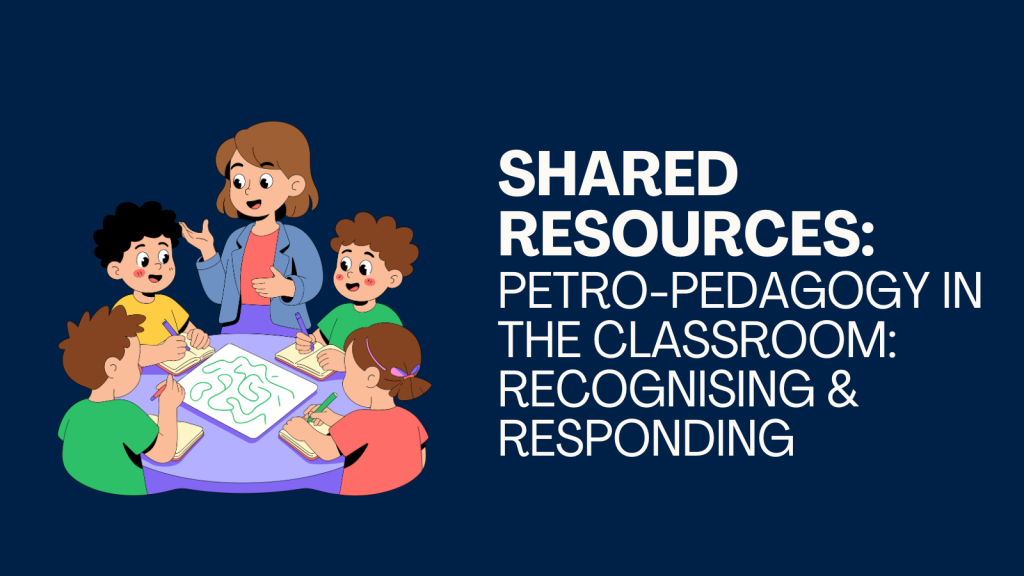

This resource acts as a guide for educators following a webinar into understanding and resisting the fossil fuel industry in the science and geography curriculum. The resource is compiled from webinar resources, activities, and shared links. All links were correct at time of publication.
For questions or to share additional resources, please contact the webinar organiser.
How do fossil fuel companies make their way into our classrooms? From glossy STEM resources provided by industry, to “energy literacy” programmes tied to professional sports, to entire curricular units developed by oil majors, schools are increasingly targeted as sites of influence. Scholars refer to this as petro-pedagogy: the use of teaching resources and practices that normalize fossil fuel dependence and hinder climate justice.
This webinar explored what petro-pedagogy looks like in practice — in Canada, the UK, and beyond — and considered how teachers can identify and resist it. The speakers discussed classroom examples, unpacked common strategies of industry influence, and shared approaches for building critical awareness with students without losing sight of hope and possibility.
Speakers:
Travis Fuchs: a SSHRC Canada Postdoctoral Fellow at Brock University, an Honorary Norham Fellow at the University of Oxford’s Department of Education, and Researcher in Residence at Crofton House School. He is a co-founder of the Oxford Education Deanery Sustainability Team.
Anne Keary: a researcher, climate activist, and parent based in Toronto, Canada. Originally from Australia, she holds a Ph.D. in history from UC. Berkeley. She currently serves on the Board of Environmental Education Ontario, is co-chair of Toronto Climate Action Network, and is a regional coordinator for Canadian Association of Physicians for the Environment. She is lead author of Polluting Education: The Influence of Fossil Fuels on Children’s Education in Canada, 2025.
Alexis McGivern: Head of Stakeholder Engagement and a Research Fellow at Oxford Net Zero, where she translates research into action to promote credible, justice-aligned net zero strategies. Her work focuses on the governance of corporate net zero commitments, advancing high-integrity guidance through voluntary initiatives and standards. Alexis’ work involves revising net zero standards for professional services providers, specifically. Alexis leads the Serviced Emissions Hub, which is a research and engagement initiative helping professional services providers (law firms, consulting firms, ad agencies) take responsibility for the climate impact of their advice. She co-created and co-leads the Global Youth Climate Training Programme, which has equipped more than 5,000 young climate activists with a deep understanding of the UNFCCC negotiations. Alexis is a member of the Greenhouse Gas Protocol’s Technical Working Group, contributing to the first revision of the Corporate Standard in two decades. In addition, she co-leads the Oxford Sustainable Business Programme, an executive education initiative designed to empower sustainability leaders.
Clarissa Salmon: a Stakeholder Engagement Officer at Oxford Net Zero, where her work focuses on corporate accountability, net zero standards and youth engagement. Through the Serviced Emissions Hub, she mobilises professional service providers to take action on the climate impact of their services. Through the Global Youth Climate Training, she supports youth engagement in the UNFCCC. Clarissa also works at UCL as a Community Research Initiative Coordinator, supporting knowledge exchange and community engaged research. She is the youngest ever trustee of the Climate Coalition, the UK’s largest climate and nature coalition, where she brings an intergenerational perspective to the board.
Foundation Reading
The webinar was built around two key pieces of research. We recommend reading these before exploring the activities below.
Primary article
- Travis T. Fuchs (2026) — Recognising and Addressing Petro-Pedagogy in the Geography Classroom. Geography, 111(1), pp. 24–29. DOI: 10.1080/00167487.2026.2604987
Supporting report
- Keary, A. and Chestnut, J. (2025) — Polluting Education: The Influence of Fossil Fuels on Children’s Education in Canada. Published by the Canadian Association of Physicians for the Environment and For Our Kids. Download the full report (PDF)
Note: This report includes references to a searchable database (found here) documenting oil and gas company involvement in Canadian schools — a powerful illustration of the scale of industry reach into education.
Classroom Activities
The webinar introduced practical activities for both teachers and students to identify and respond to petro-pedagogy.
For teachers — Spotting Fictitious Industry Resources:
This activity asks teachers to critically examine example classroom resources that have been influenced or created by fossil fuel companies. Working through these fictitious examples builds the skills to identify petro-pedagogy in real materials.
- Activity website: Webinar Website with Fictitious Resources
For students — Anti-Greenwashing Toolkit:
These resources give students practical tools to identify greenwashing -when companies exaggerate or misrepresent their environmental commitments.
- Interactive kit: Anti-Greenwash Education — An interactive toolkit for students to practise spotting greenwashing claims.
- Printed guide: The Anti-Greenwash Guide (Creatives for Climate) — A clear, visual guide students can work through independently or in groups.
Youth Climate Leadership
These resources were recommended in response to a question about highlighting youth leadership on climate. They are useful if you want to inspire students or make the link between classroom learning and real-world activism.
Youth activist profiles:
- Francisco Vera — Young Activists Summit — Francisco began climate advocacy at age 9 and is a compelling example to share with students. The wider page also features profiles of other young activists from around the world.
Training and programmes for young people:
- Global Youth Coalition — The organisation behind our Global Youth Climate Training programme, available for students aged 16 and over.
- Youth Climate Justice Fund — Funds youth-led climate projects. Their site features impact stories and funded project examples.
- HERO App — Funds and profiles climate activists (slightly older audience than school students, but useful for inspiration and browsing).
Further Reading & Links
These links were shared by participants or the facilitators during the webinar to illustrate key themes — from real-world examples of petro-pedagogy to media literacy frameworks.
Real-world examples of fossil fuel messaging:
- ‘Coalie’ — the US government’s fossil fuel mascot (The Guardian, 2026) — A recent example of fossil fuel promotion through a cartoon character, illustrating how pro-fossil-fuel messaging can be packaged for public audiences.
- Canada cracks down on fossil fuel advertising (CBC, 2024) — Explores regulatory responses to fossil fuel advertising in Canada.
- Tobacco and fossil fuel advertising — the parallels (YouTube Short) — A short video drawing parallels between how the tobacco industry and fossil fuel companies have used advertising strategies to shape public perception.
Media literacy:
- Media Literacy Is About Where to Spend Your Trust — Mike Caulfield (2018) — A widely-cited blog post arguing that media literacy education should focus on helping students decide where to place their trust, not just how to doubt everything. Useful framing for classroom discussions.
Research and accountability tools:
- CLARA (Corporate Litigation & Accountability Research Assistant) — A research tool for investigating corporate accountability, useful for in-depth research into fossil fuel company conduct.