
A conceptual framework of oral language support, and a collection of resources on current research and audit tools that measure the quality of language support.
How do we support oral language development in early years education?
Young children learn language best when they are involved in back-and-forth interactions and engaged in conversations with others. To support language learning, adults are responsive to the child’s non-verbal and verbal language and make space and time for communication. They model rich language and thinking, and plan experiences that motivate children to engage in conversations.
They chose conversation topics that are meaningful, engage children in extended conversations, and are sufficiently complex to support language and thinking. To extend a child’s language skills, adults build on the child’s language skills and plan where to take them next. In early years settings, all adults in the team get involved, and working with parents is essential to support language learning in the wider context.
Conceptual Framework of Oral Language Support
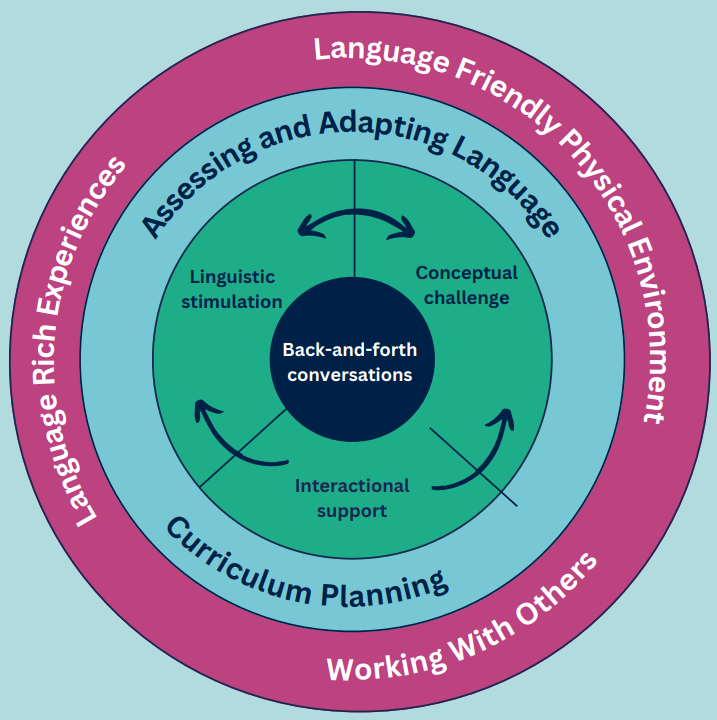
Back-and-forth Conversations
In the early years, children develop language by being involved in interactions with others. From non-verbal communication to backand-forth conversations – it is the involvement in extended turn-taking that best supports young children’s oral language development.
Interactional Support
To support children’s involvement in interactions, adults make children feel comfortable; they recognise, acknowledge and respond to what children are engaged in and communicate; they show that they are listening, and they encourage children to talk.
Linguistic Stimulation
The most effective way for adults to model language is to adapt the language they use when interacting with individual children so that it is sufficiently rich in vocabulary and grammar to build on and extend the child’s language skills.
Conceptual Challenge
Focusing conversations on interesting and sufficiently complex topics helps to extend conversations and supports the linguistic complexity of the language that is used. Importantly adults model and support rich language and the development of abstract thought by asking children to pretend, describe and explain, to reason and speculate.
Assessing and Adapting Language
To be effective in helping children develop new language skills, topics of conversations have to be interesting and meaningful to children, conceptually within the child’s level of understanding, and linguistically tailored to the child’s language level.
Curriculum Planning
Effective language support relies on careful and deliberate curriculum planning that supports planned and incidental language supporting interactions. Adults think about what children know and can do, what they want them to learn, and which techniques will best support their learning.
Language Rich Experiences
Experiencing enough planned and incidental interactions with adults secures the learning educators intend. Educators therefore need to engage children in activities across contexts that help to introduce and embed vocabulary and language structures. This should include oral storytelling and discussions during shared book reading.
Language-Friendly Physical Environment
The language learning environment has to facilitate children accessing language input, and resources that will help to engage them in language rich experiences. Elements to consider are the
space, layout of the room, visual displays, the level of distractions and noise, and books and resources for play.
Working With Others
Language supporting interactions don’t take place between one educator and an individual child – the whole team in an early years setting, and other people in the child’s life (most importantly the parents) are involved, and by working together they can best a child’s support learning.
Research and Audit Tools
Below are some key documents the researchers Ereky-Stevens, Gardner, Sylva and Lindorff identified when carrying out a review in 2023 to inform the development of a self-report questionnaire for early years practitioners and educators.
- Communication Supporting Classroom Observation Tool (Dockrell et al., 2012)
- Early Childhood Environment Rating Scale-Revised (ECERS-R; Harms et al., 1998)
- Early Childhood Environment Rating Scale Curricular Extension to
ECERS-R (ECERS-E; Sylva et al., 2001) - Sustained Shared Thinking and Emotional Well-Being Scale for 2-5-year-olds provision (SSTEW; Siraj et al., 2015)
- Teacher Interaction and Language Rating Scale (Girolametto et al., 2000)
- Observing Language Pedagogy Instrument (Mathers et al., 2022)
- Communication Friendly Environment Checklist (ICAN & The Communication Trust)
- The Early Years Communication Commitment Review Checklist (ICAN & The Communication Trust)
- Early Years Setting Audit for a Communication Friendly Environment (Early Years Alliance, 2011)
Guidance Documents
- Supporting you to meet curriculum requirements for communication and language
Help for Early Years Providers. Department for Education, 2023 - Approaches and practices to support communication and language development in the early years
Education Endowment Foundation, 2022 - Developing young children’s knowledge and skills in communication and language
OFSTED, 2023 - Development Matters. Non-statutory curriculum guidance for the Early Years Foundation Stage
Department for Education, 2023 - Non-statutory guidance for the Early Years Foundation Stage
Early Years Coalition, Early Education, 2021 - Supporting children with speech, language and communication needs
Guidance for practitioners in the Early Years Foundation Stage.
Department for Children, Schools and Families & ICAN, 2008 - Resource library for educators
Info pages on how to support children facing challenges with talking and understanding words.
Speech and Language UK, 2023 - Language development in the Early Years
National Education Union & Speech and Language UK, 2023 - Speech and language support for 0-3s
Training to support children’s language and learning.
Elklan, 2023 - Speech and language support for 3-5s
Training to support children’s language and learning.
Elklan, 2023
LangQuest-EY Questionnaire
This questionnaire assesses practitioner confidence in using language supporting practices.