



Welcome
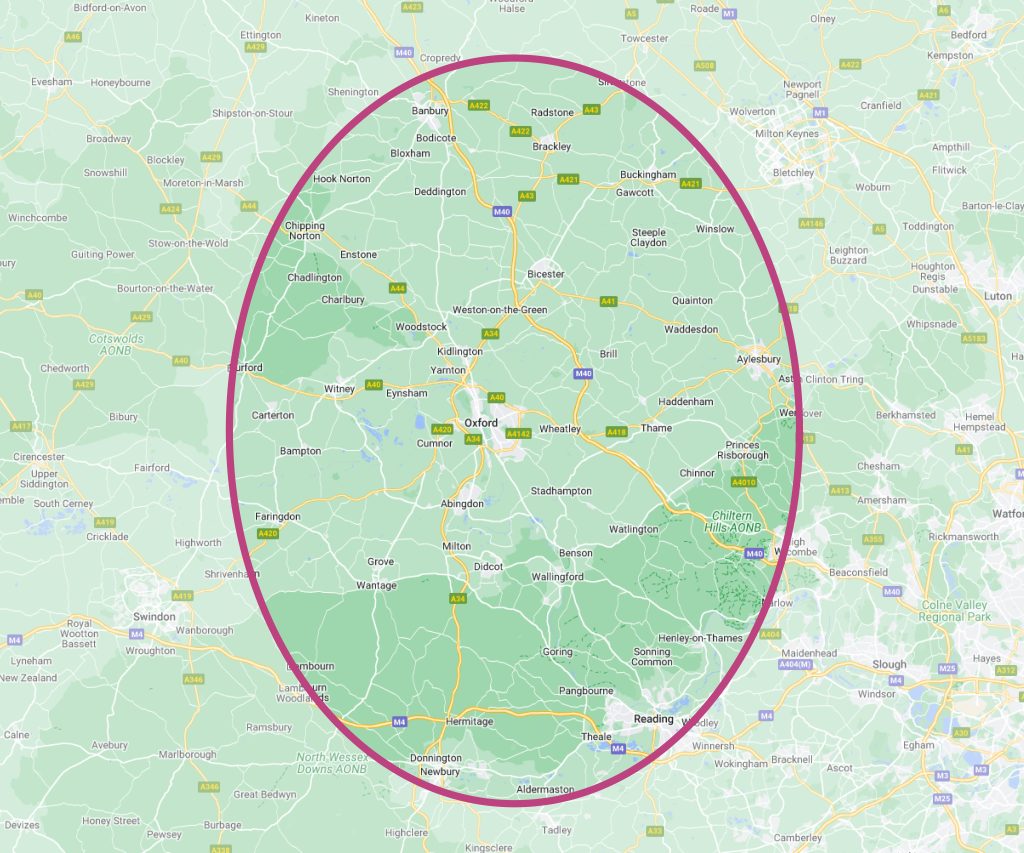
The Department works in partnership with over 39 secondary comprehensive schools in Oxfordshire and neighbouring counties, with most being within 30 miles of Oxford.
We work on an internship model (the Oxford Internship Scheme) which recognises the different roles of university and schools in teacher education and the need for a truly collaborative partnership. Such collaboration involves joint responsibility within the partnership for the planning, delivery and assessment of the programme.
All of our PGCE programmes run on a full-time basis for one academic year.
In addition to being awarded the PGCE qualification, successful students are also recommended for Qualified Teacher Status, which indicates that they have met the requirements of the Government’s Teachers’ Standards.
Our PGCE offers you excellent career prospects.
As of October 2023, 94% of our 2022-23 student cohort were employed as a teacher or seeking teaching roles; of those who had specified their destination to us 72% were working as a teacher in the state sector and 42% were working in a partnership school.
Student statistics for 2023-24 entry
- Application success: we accepted 1 in 3 applications
- 50% of course starters were aged 24 and under, 81% were 29 or under
- 6% of our students had previously studied at Oxford
- 35% of our students had never studied at a Russell Group University before
- Highest qualification: Undergraduate: 84%; Master’s: 15%; PhD: 1%
Our Core Values
The University of Oxford is one of a number of university-based initial teacher education providers committed to producing outstanding teachers who think critically and systematically about their classroom practice, respond creatively and effectively to new challenges, and contribute to the development of their profession at both a theoretical and practical level. This makes a lasting, positive impact on the lives and learning of the pupils they teach.
Entry requirements
You will need an undergraduate degree at class 2:2 or above, or equivalent.
It is important that your degree is directly related to the PGCE subject you wish to teach.
Apply Now
Applications for September 2026 entry open in October 2025. Apply through the Department for Education’s site.
About the course
We offer the PGCE in the following subject areas:
- English
- Geography
- History
- Mathematics
- Modern Languages (Any two of French, German, Spanish, Mandarin)
- Science (Biology, Chemistry, Physics)
- Mandarin (hybrid online/in person)
The course structure
The course begins with an orientation experience in September in a primary school of your choice.
This is followed by the first week of seminars at the University of Oxford’s Department of Education. The rest of the autumn term is made up of ‘joint weeks’ with days spent in the University and days in school. You will be attached to the same school for the majority of the year, which makes it possible for you to get to know teachers and pupils in the school and to understand the school’s policies and practices.
The spring term consists primarily of school experience and for the summer term, interns move to a second school so that they have the opportunity to consolidate and extend their understanding and experience of learning and teaching.
This course structure reflects the internship model in that it is designed to:
- enable interns to become fully integrated into one school over a long period.
- enable interns to learn about their own teaching in the context of the wider school, rather than focusing initially on their own classroom and only later widening their view.
- allow schools to offer coherent and challenging professional development programmes over the course of the long placement, and in the short placement focus on preparation for continuing professional development.
- enable school-based tutors to see interns’ development from the start of the course to a position of competence.
- offer interns the opportunity to encounter a new school context at a time of the course when they are ready to make critical comparisons
Components of the PGCE course
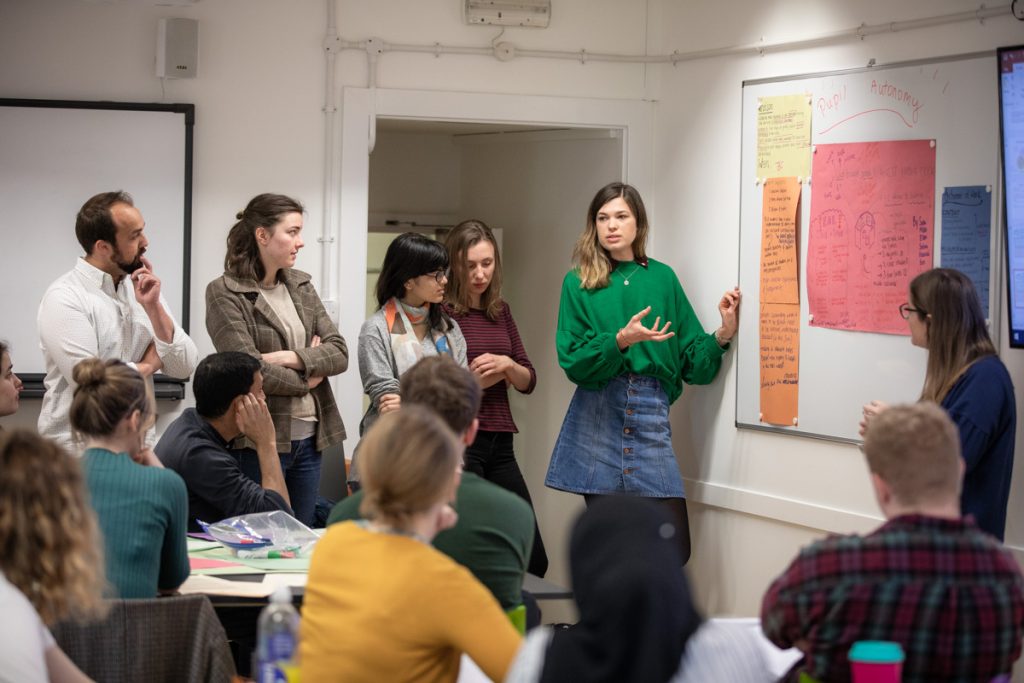
Curriculum work includes a range of activities related to the teaching of a specific subject in the secondary school. These activities include seminars and workshops in the University, as well as collaborative teaching, solo teaching, observation and discussion in school. The activities are aimed at giving interns competence in teaching their subject, the opportunity to develop a range of teaching strategies, and an understanding of wider issues affecting the teaching of those subjects within the whole school curriculum.
The work in each subject is organised by the Curriculum Tutor and school-based mentor for that subject. Part of the work in each subject area is planned for all interns, and part develops from the progress of individual interns.
An experienced teacher (or mentor) co-ordinates the subject–related classroom–based activities of the intern. The mentor provides guidance and support and, as the year goes by, judges when and how to increase an intern’s experience and responsibilities.
Interns complete two written assignments related to their subject teaching. These involve school–based investigation and the critical analysis of relevant research and professional literature.
The professional development programme (PDP) involves a range of activities related to important educational issues. These activities include lectures in the University, weekly seminars in school and an assignment focused on a specific aspect of schooling of the interns’ own choice. These activities are aimed at giving interns an understanding of whole-school and cross-curricular issues, and an appreciation of the contribution which they can make to developing these issues through teaching their own subjects.
The Professional Tutor responsible for interns at the school co-ordinates school based activities related to general educational issues, called the school professional development programme.
Some aspects of the PDP are planned and organised for all interns by university tutors, who take responsibility for particular issues. The detailed programme for the interns in each school, however, is organised by the Professional Tutor and General Tutor for that school.
Assessment
The PGCE at Oxford is assessed as an M level course (in line with the National Qualifications Framework for Higher Education). Successful completion of the examined assignments at master’s level carries the award of 60 M level credits. Those who pass the assignments at Honours level can be awarded a Professional Graduate Certificate in Education (provided that their practice also meets the Teachers’ Standards).
Find out more about the Professional Development Programme (PDP) with Dr Katharine Burn
English

Course code Q3X1
The PGCE Internship programme in English is designed to prepare you to teach the subject in comprehensive schools. It aims to help you make the complex transition from having been a successful student of English in higher education to becoming a successful school teacher.
The English programme has been developed with colleagues from our partnership schools and is based upon the following core principles:
- The view that the creative, imaginative and expressive aspects of the subject have a key role in pupils’ learning
- The view that English teachers should write for pleasure, read widely for enjoyment and participate in cultural events in their school and in the wider community
- The view that English teachers should share their experiences as writers, readers, speakers and listeners with their pupils
- The understanding that writing is a practice that covers a wide range of processes, functions, rhetorical situations, and categories of discourse
- A broad view of what constitutes text and the understanding that technological innovation can change both what is considered as text, how text is prepared and how it may be interpreted
- The importance of literature in the development and understanding of human cultures and in personal, social and ethical development
- The importance of diversity in reading practices and the value of a range of interpretative approaches to texts
- An understanding of the English language at word, sentence and text level Recognition and respect for varieties of language and languages
- A belief that English, as a subject, involves the development of social relationships and collaborative work
- The inter-relationship of speaking, listening, reading and writing
In addition, the programme covers the key professional skills of:
- Lesson and course planning and preparation
- Assessment, recording and reporting
- Responding to individual learning needs
- Classroom behaviour and management
English teaching in England is subject to continuous change and development. The Internship English programme is intended to enable beginning teachers to meet the challenges of change confidently and creatively.
Assessment of your progress and achievements are jointly carried out by your schools and the university, and you take part in informal and formal discussions about this. Continuous assessment is used throughout the course and there are no examinations.
We look for applicants with a good degree in English or a degree in another subject that involves textual study together with further degree-level work (through the Open University, for example) in English. We of course welcome applications from those with degrees in English Language or Linguistics as well as in English Literature.
If you think Oxford isn’t for people like you – talk to us! More than three quarters of our interns have degrees from outside Oxbridge.
Watch student, Daisy, give her account of the PGCE English course
Watch student, Jamilyn, give her account of the PGCE English course
Geography
Course code F8X1
Learning to become a Geography teacher at Oxford is challenging, stimulating, very rewarding and thoroughly enjoyable. The subject naturally lends itself to a huge range of student learning activities, both in the classroom and in the field, and most interns find this diversity one of its attractions.
The main aims of the geography course are to provide the foundations for you to become an inspiring and effective geography teacher of young people who now find themselves living in a fast-changing world, and to quickly become innovative leaders in the field.
Central to the course is the basic tenant that all young people, regardless of social class, race, ethnicity, gender or ability can learn and enjoy geography, and that geography, as a discipline, has a significant contribution to make to the broader aims of education.
The idea of ‘subject’ is central to the design of the course and we encourage you to engage critically with ongoing policy and academic debates about what kinds of geographies are fit for a 21st century education system.
By the end of the course, you should:
- be competent in the skills of teaching geography, as specified in the Standards for the award of Qualified Teacher Status.
- understand the contribution that you as a geography teacher can make to the education of pupils in the widest sense.
- be able to take responsibility for your continuing professional development.
The course consists of an integrated programme of lesson observations, school-based activities, teaching and reflection in school and university workshops, lectures, tutorials and fieldwork. In school you will begin by working with teachers and small groups of pupils. As your confidence grows, you will plan and teach lessons with a class teacher and with other interns, sometimes working with a group of pupils, sometimes with a whole class.
In the University, you will work with the other geography interns, and with the geography education tutors. You will be expected to read and to think about teaching in a critical and theoretical way, taking account of your own ideas about the sort of teacher you would like to be.
You will be able to make a real difference to pupils, fostering their learning of the important issues which shape the future.
All geography interns gain fieldwork experience in their schools and through the university in a range of locations. The practicalities of organising such trips are also explored in departmental sessions
Assessment of your progress and achievements are jointly carried out by your schools and the University, and you take part in informal and formal discussions about this. Continuous assessment is used throughout the course and there are no examinations.
We welcome applications from candidates who have studied Geography or a degree in a related area, such as Geology. Applications from those who may need to complete a Subject Knowledge Enhancement course are also welcome. If you are uncertain about the appropriateness of your degree, please contact the PGCE Office.
Watch student, Daniel, give his account of the PGCE Geography course
History
Course code V1X1
We are committed to enabling you to teach history in rigorous ways while taking account of the learners’ needs, desires and dispositions, across a range of different contexts. Our course is based on a strong set of partnerships built over a long period of time with local schools. This partnership extends to include visits to local museums, a local case study and visits to a number of London schools to explore EAL and diversity issues. We have a real passion for history and young people and are looking for candidates that share this passion. Our course looks to support successful history teaching based on the use of engaging and rigorous historical enquiries that link substantive historical knowledge with critical historical thinking.
Course development evolves in response to feedback from all PGCE partners, combining insights from up–to–date research with the perspectives of PGCE students and their mentors. The course integrates teaching experience in partner secondary schools with practical university-based workshops and helps you develop teaching skills and a critical understanding of learning and teaching across a range of different contexts.
The curriculum programme is organised around six broad themes:
- Exploring your preconceptions about the nature of history and about effective teaching and learning
- The context of history teaching today, including the nature of the history curriculum itself (Key Stage 3, GCSE and post-16), the relationship between history and citizenship education and the wider professional context of teachers’ work
- Managing history classrooms
- Planning for learning – exploring the range of decisions that you need to make in planning for single lessons and longer schemes of work, examining the range of goals and activities possible, and the ways in which you can select and tailor your objectives and learning tasks to ensure that all pupils are engaged and can make progress
- Carrying out your plans
- Evaluation: of both your own teaching and the pupils’ learning in history
In school you will be involved in all aspects of a teacher’s role. You will observe experienced teachers and discuss your observations and your own developing ideas and practice with them, plan and teach collaboratively, and design and develop resources for that teaching. You will work both with individuals and small groups of pupils, as well as taking responsibility for teaching history to whole classes. In the University you will work with other history interns in seminars and workshops using a wide variety of approaches intended to develop your own repertoire and understanding of effective teaching and learning strategies, informed by both practical and research-based, theoretical perspectives. One key aspect of the PGCE programme is the space to share knowledge and understanding of the variety of contexts.
Assessment of your progress and achievements are jointly carried out by your schools and the University, and you take part in informal and formal discussions about this. Continuous assessment is used throughout the course and there are no examinations.
We welcome applications from candidates who have not studied History but have completed a degree in a related area, such as Law or Sociology. If you are uncertain about the appropriateness of your degree, please contact the PGCE Office.
Watch Dr Katharine Burn, PGCE Course Director, tell us about the PGCE History course
Watch student, Melissa, tell us about her account of the PGCE History course
Mathematics
Course code G1X1
The aim of the Mathematics course is to help you to become an effective secondary school teacher of mathematics. To help you achieve this goal, we teach you through a variety of styles, paces, approaches and presentations in the hope that you will use a similar variety when you teach. Learning mathematics can be challenging. It requires concentration, and can feel like hard work, but it also has the ability to surprise, and to give a sense of achievement and enjoyment. Learning to be a teacher will be all of these things too. Teaching on the PGCE course is strongly informed by the mathematics education research which takes place in the Department, some of which is undertaken collaboratively with partner schools. Course tutors are active researchers and experienced in writing for teacher trainees and practising teachers of mathematics.
Objectives of the course
- To provide mathematical experiences on which you can reflect as a learner, and relate these to planning for teaching
- To offer insights into children’s learning and, through recognition of their particular conceptions, to help you plan your teaching accordingly
- To provide skills and experiences in planning, teaching and managing effective lessons through which learners can gain mathematical knowledge, awareness and understanding
- To help you to reflect on and analyse your teaching, and make decisions about how to modify and adapt it to be more effective for students’ learning
- To introduce you to a range of resources, research and theoretical perspectives on which to base your growth as a teacher
- To enable you to develop skills and experience in ICT that will support your teaching and its management
Main themes of the course
- Developing reflective teaching (DRT): in which you think about your practice in a professional, developmental manner
- Learners’ mathematical development (LMD): in which you think about mathematics and lessons from the point of view of how learners think
- Teaching and learning a topic (TLT): in which you learn how to structure mathematical knowledge so that your teaching is effective
- Planning and management (PM): in which you look at planning and managing lessons, classrooms, professional work and yourself
Assessment of your progress and achievements are jointly carried out by your schools and the University, and you take part in informal and formal discussions about this. Continuous assessment is used throughout the course and there are no examinations.
You are encouraged to apply if you are committed to teaching mathematics in state comprehensive schools, can demonstrate your commitment to working with children in schools through voluntary work or other experience, have a good degree (a 2:2 or above) in mathematics or a mathematics-related subject such as engineering or economics, and can provide an excellent academic or work reference. Applications from those who may need to complete a Subject Knowledge Enhancement course are also welcome. If you are uncertain about the appropriateness of your degree,please contact the PGCE Office.
Watch student, Joanna, give us her account of the PGCE Mathematics course
Modern Languages
The University of Oxford offers a PGCE in Modern Languages (Chinese (Mandarin), French, German and Spanish).
We expect you to be able to offer two Modern Languages from the four listed above, and we can provide a range of placements for various combinations of these languages. We may not be able to offer you an interview if we do not have school placement capacity in your preferred language combination.
It is important that you have qualifications in both the languages that you wish to teach. For your main language, these qualifications should preferably be at university level, or you should have it as one of your first languages, e.g. have spoken it from a young age. You will be expected to teach your main language up to and including A-level.
For your second language, your qualifications should preferably be at A-level or equivalent (B2 CEFR level). You will be expected to teach your second language up to age 14 as a minimum.
The Modern Languages PGCE course is designed and implemented jointly by colleagues in schools and the University working in close partnership. It is not our aim to prescribe particular approaches to teaching Modern Languages, but rather to enable you to draw on the full range of different sources available to you for your own professional learning – and in so doing to develop a clear and reasoned understanding of the sort of teacher that you want to become. Tutors on the course, who have many years of classroom teaching experience as well as teacher training experience, will guide you and support you in this exciting but challenging process.
Our course will help you to become an effective and confident teacher by providing you with the following:
- Opportunities to observe other practitioners in the classroom and to understand their decision making
- Insight into theories and findings from research into Second Language Acquisition, helping you to understand how adolescents learn a modern language in a classroom setting
- Opportunities to learn from school students themselves about their experiences of language learning and the barriers they encounter
- Opportunities to learn from, and share good practice with, other beginning teachers working in different school contexts
- Practical advice on: the preparation, teaching and evaluation of languages lessons; how to assess and monitor students’ progress; promoting positive behaviour for learning; and responding to the diverse needs of individual students
- Opportunities to try out and systematically evaluate a range of teaching approaches in a range of classrooms over an extended period of time
- Many ideas for using and adapting a range of modern language materials in the classroom
Assessment of your progress and achievements are jointly carried out by your schools and the University, and you take part in informal and formal discussions about this. Continuous assessment is used throughout the course and there are no examinations.

Student Ye-Ye Xu (French with Mandarin 2020-21) discusses her PGCE experiences in this podcast.
Watch Modern Languages PGCE student, Constance, tell us about her experience
Watch Modern Languages PGCE student, Phil, tell us about his experience
Mandarin
The main aims of the Mandarin PGCE programme are to provide the foundations for you to become an inspiring and effective teacher of Mandarin to young people who find themselves living in a fast-changing world, and quickly to become innovative leaders in the field.
Course Structure
The course comprises:
- in-person teaching during specific weeks of the academic year (the first week of the PGCE term, part of one week in mid-October, a week in February and a week in April)
- distance learning via Teams on the Monday and Friday of each week during Term 1 (September to December)
- school placements (in S1, the main school placement from September through to the school Easter break, and then S2, a different school from April through to the end of June).
This is a bespoke arrangement for the Mandarin PGCE but, other than these specific arrangements, the Mandarin PGCE will align with aspects of the main PGCE more generally, including all assessment arrangements.
An innovative aspect of this new programme will be that placements will not primarily be in the Oxford area but will, instead, be spread across England, hence the distance learning nature of the programme. It should be noted that, even if a placement does happen to be local to the Oxford area, then PGCE Mandarin interns will still follow the model described above and will not have face-to-face tuition other than during the designated weeks at the Department.
Entry Requirements
If you are considering applying, it is important that you have an appropriate subject-specific degree level qualification which will enable you to teach Mandarin or, if you have Mandarin as your first language, that your degree-level qualification is in Mandarin Education or a related field. You will be expected to teach the subject up to and including A-level. Applicants with Mandarin as their first language who are only able to offer a degree in an unrelated discipline will not be considered for the programme.
Course Content
The Mandarin PGCE course is designed and implemented jointly by colleagues in schools and the University working in close partnership. It is not our aim to prescribe particular approaches to teaching Mandarin, but rather to enable you to draw on the full range of different sources available to you for your own professional learning – and in so doing to develop a clear and reasoned understanding of the sort of teacher that you want to become. Tutors on the course, who have many years of classroom teaching experience as well as teacher training experience, will guide you and support you in this exciting but challenging process.
Our course will help you to become an effective and confident teacher by providing you with the following:
- Opportunities to observe other practitioners in the classroom and to understand their decision making
- Insight into theories and findings from research into Second Language Acquisition, helping you to understand how adolescents learn Mandarin in a classroom setting
- Opportunities to learn from school students themselves about their experiences of language learning and the barriers they encounter
- Opportunities to learn from, and share good practice with, other beginning teachers working in different school contexts
- Practical advice on: the preparation, teaching and evaluation of languages lessons; how to assess and monitor students’ progress; promoting positive behaviour for learning; and responding to the diverse needs of individual students
- Opportunities to try out and systematically evaluate a range of teaching approaches in a range of classrooms over an extended period of time
- Many ideas for using and adapting a range of teaching materials in the classroom
Assessment of your progress and achievements are jointly carried out by your schools and the University, and you will always take part in informal and formal discussions around this. Continuous assessment is used throughout the course and there are no examinations.
Science
Course codes: Biology C1X1 Chemistry F1X1 Physics F3X1
The teaching of the sciences in schools is normally organised within a single Science department or faculty to which teachers from the different sciences contribute their respective expertise. Such a structure is reflected in the Oxford Department which, while actively recruiting for trainee teachers of the separate sciences – biology, chemistry and physics – works as a co-ordinated team of scientists.
The course aims to produce high quality teachers of the sciences across the 11-19 age range who will not only become competent teachers but will quickly become innovative leaders in their field. Interns will gain expertise in the different strategies for teaching science and will get insights into the way that pupils learn across the whole range of attainments, aptitudes and pupil differences.
Interns will learn how to turn their own subject knowledge into a form that can be appreciated by pupils and will think critically about the aims and practicalities of teaching science in schools. To attain these goals, interns work with each other, the University tutors and their mentors in schools as adult learners, motivated to take responsibility for their own learning. The learning is structured through workshops, seminars, discussions, focussed assignments, school-based activities and sympathetic, expert, supervision and support. There are opportunities to prepare science lessons, in particular, by trying out practical work both here in the Department as well as in school. Between them the six science tutors cover such subjects as biology, chemistry, physics, earth and environmental sciences. All have extensive experience of teaching and are involved in curriculum developments and research in science education at national and international level.
Rather than attempt to train all interns to teach in a particular way, we aim to build on your existing strengths – as good scientists and as mature, autonomous, motivated personalities – to help you teach in the way most suited to you and your school students.
The teaching of the sciences in schools is normally organised within a single Science department or faculty to which teachers from the different sciences contribute their respective expertise. Such a structure is reflected in the Oxford Department which, while actively recruiting for trainee teachers of the separate sciences – biology, chemistry and physics – works as a co-ordinated team of scientists.
The course aims to produce high quality teachers of the sciences across the 11-19 age range who will not only become competent teachers but will quickly become innovative leaders in their field. Interns will gain expertise in the different strategies for teaching science and will get insights into the way that pupils learn across the whole range of attainments, aptitudes and pupil differences.
Interns will learn how to turn their own subject knowledge into a form that can be appreciated by pupils and will think critically about the aims and practicalities of teaching science in schools. To attain these goals, interns work with each other, the University tutors and their mentors in schools as adult learners, motivated to take responsibility for their own learning. The learning is structured through workshops, seminars, discussions, focussed assignments, school-based activities and sympathetic, expert, supervision and support. There are opportunities to prepare science lessons, in particular, by trying out practical work both here in the Department as well as in school. Between them the six science tutors cover such subjects as biology, chemistry, physics, earth and environmental sciences. All have extensive experience of teaching and are involved in curriculum developments and research in science education at national and international level.
Rather than attempt to train all interns to teach in a particular way, we aim to build on your existing strengths – as good scientists and as mature, autonomous, motivated personalities – to help you teach in the way most suited to you and your school students.
Aims of the course
- To develop as a professional
- To explore your pre-conceptions about science and teaching science, and draw on your teaching experiences in a positive and reflective way
- To have opportunities to use research and academic study to inform your thinking and practice
- To learn how you can plan lessons which take account of how students learn science, so that you can? develop their scientific understanding and investigative skills
- To organise and manage school science lessons which are safe and secure learning environments
- To contribute to students’ understanding of science in society, citizenship and development of literacy and mathematical skills
Assessment of your progress and achievements are jointly carried out by your schools and the University, and you take part in informal and formal discussions about this. Continuous assessment is used throughout the course and there are no examinations.
We welcome applications from candidates who have studied Biology, Chemistry or Physics or a degree in a related area, such as Earth Sciences, Engineering, Environmental Science, Materials or Zoology. Applications from those who may need to complete a Subject Knowledge Enhancement course are also welcome. If you are uncertain about the appropriateness of your degree, please contact the PGCE Office.
Watch Lead PGCE Science Tutor, Dr Judith Hillier, tell us about the main PGCE Science course
Watch student, Ed, give us his account of the PGCE Physics course
Watch student, Rebecca, give us her account of the PGCE Chemistry Course

PGCE Science student, Jacob, gets a big hug from one of the snakes during an end-of-term reptile science lab visit!
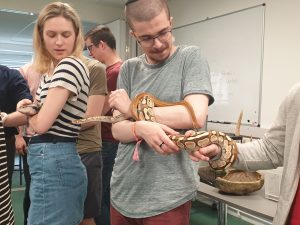
PGCE Science student, Lucy, is not scared of her new acquaintance!

PGCE Science student, Euan, has discovered a natural bond with reptiles in our end-of-term reptile science lab visit.
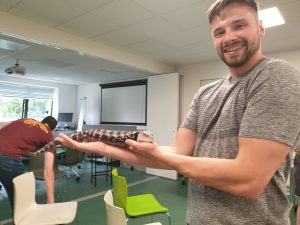
Thomas, our PGCE Science student, makes friends with a reptile in our end-of-term science lab visit.
Apply Now
Applications for September 2026 entry open in October 2025. Apply through the Department for Education’s site.
Meet our students
A key strength of our PGCE programme is the cohort of students themselves, who create a network of peer support to one another during their studies.
This also provides the opportunity to compare and contrast knowledge and teaching experiences between a variety of different schools. Discover more by reading some of their stories below.

The other interns are an amazing source of support as we can share stories with each other and turn to each other for our opinions on certain things. The tutors in the department are also a great help and are available for you to meet whenever you need them.

The interview was actually an enjoyable experience. The tasks we were asked to do were interesting and enjoyable for historical minds, and the interview itself was relaxed and friendly.

The Oxford PGCE programme has a very good reputation. Indeed, the University and Oxford itself are ideal locations to live and study in.

I had the incredible opportunity of doing a one-week placement at Swiss Cottage School along with five more students. The knowledge I gained about SEN students helped me to understand my pupils more and I saw ‘teaching’ in a different light. Furthermore the amount of teaching ideas I learnt there were key to my development as a new beginning teacher.

I was impressed by the mix of rigorous academic training and practical placement experiences. I felt that I was challenged equally by the pedagogical theory taught during the department weeks and the teaching practice that I received in both of my placement schools.

I can’t recommend the PGCE at Oxford highly enough. It kick-started my career in education by giving me the skills to develop situated methodologies for my classroom, drawing on practical understandings as well as education research.

I found the course to be interesting, informative and hard work. The staff in the Education department are extremely supportive and I always felt that they fought my corner when I needed it, which was amazing.
Apply Now
Applications for September 2026 entry open in October 2025. Apply through the Department for Education’s site.
Partnership schools
Study for your PGCE with us and you will benefit from our unrivalled relationship with local schools. We enjoy close links with more than 37 well established partner schools across Oxfordshire and neighbouring counties.
Our partnerships, developed over many years, will enrich and inform your teaching experience, setting you on a path towards a bright future in the classroom. The non-selective, state-funded schools are all located in easy travelling distance across Oxfordshire and neighbouring counties. They offer genuine diversity, both in terms of intake and location. You will work in two of the schools, enabling you to experience and compare different approaches to policy and practice.
School placements are allocated by your tutor and would depend on a school’s capacity for subject specialisms, your circumstances (e.g. childcare, disabilities), where you live, transport and your training/development plan. You will be expected to travel regularly between home, the Department and partnership schools. You would also be responsible for organising your own transport.
Watch partnership school Professional Tutor, Rob, give his account of how he supports PGCE Interns
Apply Now
Applications for September 2026 entry open in October 2025. Apply through the Department for Education’s site.
Finance
UK Government Teacher Training Bursaries & Scholarships 2026/27
Postgraduate bursaries are tax-free payments you receive if you’re training to teach certain subjects. You do not need to apply for a bursary, you’ll automatically get one if you’re eligible.
Postgraduate scholarships are awarded by organisations with a passion for their subject area. They combine tax-free payments with extra benefits like subject-specific support, mentoring and networking opportunities. If you’re eligible, you can apply directly to the scholarship provider.
The PGCE course fees (Home: £9,790; Overseas: £40,710) are due before any teacher training bursary or scholarship is paid. Therefore, a teacher training bursary or scholarship cannot be relied upon to cover the course fees.
Students cannot receive a bursary and a scholarship. Both the bursary and scholarship are tax-free and are paid via monthly instalments directly into your UK bank account whilst you study. All students are given an application form once an offer to study the PGCE at the University of Oxford has been accepted.
Teacher training bursaries and scholarships are separate from any Student Finance application. Students could receive all three types of funding: tuition fee loan, maintenance grant and a teacher training bursary/scholarship.
Postgraduate bursaries and scholarships for PGCE students are as follows:
| Subject | Bursary | Scholarship |
| Biology | £5,000 | |
| Chemistry | £29,000 | £31,000 |
| Geography | £5,000 | |
| Languages (French, German and Spanish only) | £20,000 | £22,000 |
| Languages (all other languages, including ancient languages) | £20,000 | |
| Maths | £29,000 | |
| Physics | £29,000 | £31,000 |
A scholarship award will replace a government teacher training bursary. Students cannot hold a teacher training bursary and a scholarship.
Please visit Funding: initial teacher training (ITT), academic year 2026 to 2027 – GOV.UK (www.gov.uk) for more information.
Oxford Bursary
Home or Republic of Ireland PGCE students who are not in receipt of a teacher training bursary or scholarship, and who are from lower income households are eligible to be assessed for an Oxford Bursary. There is no additional application as the Oxford Bursary is based on the household assessment carried out by your regional student finance funding agency. Eligible students could receive up to £4,320. Please visit the Oxford Bursaries page for more details.
Apply Now
Applications for September 2026 entry open in October 2025. Apply through the Department for Education’s site.
FAQs
When do applications open?
Applications for September 2026 entry open in October 2025. Apply through the Department for Education’s site.
When do applications close?
There are no formal application deadlines for the PGCE at the University of Oxford. The University tutors continually review new applications until spaces for each subject are filled. If you meet our entry requirements, we encourage you to submit your competitive application as soon as possible.
Do you offer a Primary PGCE?
No. The PGCE course at the University of Oxford works exclusively with state-funded secondary schools.
Tuition Fee and Maintenance Loans
Students who are entitled to support under the student finance criteria can apply for:
- A tuition fee loan of up to £9,535 to cover your teacher training (‘Home’ student fee level), so you do not need to pay course fees upfront
- A maintenance loan to help with living costs
You can still apply for a tuition fee and a maintenance loan if you already have a student loan, and regardless of whether you get a teaching bursary or scholarship. You will only have to make loan repayments once you are earning. Your repayments will not increase if you already have a student loan and take an additional loan for teacher training.
Please note that if you are not eligible for ‘home’ fees, the international fee level for entry in 2026-7 is £40,710.
I have applied. When will I receive a response?
We will review and process your application as quickly as possible. This typically takes up to 2 weeks. If you meet the selection criteria for interview, you will be contacted by email and invited for an interview. If your application does not meet the selection criteria, it will be rejected on the DfE Apply system. After being interviewed, it typically takes 2 weeks to receive an outcome.
Do you offer distance learning?
The PGCE is a full-time course requiring attendance at the University and in school for placements. It is not possible to take this course through distance learning.
Will I be required to travel for my interview?
All applicants shortlisted will be interviewed online via Teams.
What degree class do I need?
Applications are welcome from candidates with a 2:2 classification or higher. In all cases we review both your academic history and your attitudes towards teaching. Consequently, we would also encourage applications from those who have extensive UK school experience and a 3rd class classification. Honours classification would be competitive but is not essential when applying for the PGCE, however it will be essential for any teacher training bursary or scholarship application.
Do I need to complete school experience?
Candidates are encouraged to spend at least one day of observation in a non-selective, state funded UK secondary school prior to making an application or attending an interview. If you cannot complete this observation, you can still submit an application. Although strongly encouraged, school experience is not a condition for the Oxford PGCE.
Is there a residency requirement?
All PGCE students are normally expected to live within 25 miles of Oxford’s city centre. If you are moving to Oxford for the first time, we suggest that you seek accommodation as centrally as possible, because you will then have access to more public transport options and thus can be considered for placements within more partnership schools. As the PGCE works with schools across Oxfordshire and in neighbouring counties we can consider requests to be excused from this requirement, but this is not guaranteed.
What accommodation is available?
Accommodation is not guaranteed for any student, but there are plenty of options to explore. Colleges and the Graduate Accommodation Office offer a wide range including non en-suite single rooms and private flats. Once an offer has been accepted, PGCE students can simultaneously apply for college and Graduate accommodation. If you have childcare responsibilities then advice is available from Childcare Services.
How are partnership schools allocated?
School places are decided by the Department, but are informed by students’ home location, professional preferences, caring responsibilities and disabilities. Throughout the PGCE, students experience two partnership schools. When your second school placement is decided, the Department also consider your experience so far on the course and the developmental priorities that have emerged. It is important to note that not every school will offer a training place for every subject and that a place at a particular partnership school cannot be guaranteed.
How do I select my college?
All PGCE interns are guaranteed a college place. For the PGCE, a college choice is not made at the point of initial application. If you are successful at interview and decide to accept the offer of a place from us, you will be supported to apply for a college place.
Can I be considered for a Subject Knowledge Enhancement (SKE) course?
We do set SKEs as conditions of offers. SKE courses give students the opportunity to improve their knowledge before the PGCE starts. We typically set SKE courses where students have been outside of formal education for a significant period, or when they have studied a subject related to the area that they wish to complete a PGCE in. If invited to interview there will be an opportunity to have a tailored conversation about your SKE options with the panel. If you are interested in completing a Subject Knowledge Enhancement (SKE) course then you should briefly mention this in your application form. For more information please see this website.
Do you accept international students and international qualifications?
Around two thirds of Oxford’s graduate students are international, and international students are welcome to apply for Oxford’s PGCE. Please note, our course is designed for new or inexperienced teachers who plan to teach in the UK. Although not a condition of an application or of an interview, experience within a state-funded UK secondary school is highly recommended. If this is not possible then observing elements of UK teaching outside of the UK (for example, International GCSE lessons) is also highly relevant. Although strongly encouraged school experience is not a condition for the Oxford PGCE.
International qualifications viewed as comparable to qualifications taken within the UK are accepted for the PGCE. In order for the University of Oxford to formally recognise overseas qualification the student must present a Statement of Comparability from UK ENIC.
I have a criminal conviction. Can I still get a PGCE?
In many cases, yes, but it will depend on several factors.
For the PGCE, there are two processes for considering criminal convictions: one managed by the Department of Education and the other overseen by the University’s Criminal Conviction Panel. In the first instance, your disclosure will be reviewed by the Department, and then if the conviction disclosed meets the definition of a “relevant” criminal offence, which has to be disclosed to the University as stipulated by the University, it will be considered by the University’s Criminal Conviction Panel, which will follow the University of Oxford’s Criminal Conviction policy. Find out more here.
Can I receive feedback about my application?
All unsuccessful applicants will be provided with feedback on their application via the Department for Education application system.
What if I am unhappy about the outcome of my application?
Please refer to the University guidance on complaints and appeals regarding graduate admissions decisions, available on the University website at: https://www.ox.ac.uk/admissions/graduate/applying-to-oxford/university-policies/complaints-and-appeals.
Please note that each admissions decision is made on the basis of a number of different factors and on an assessment of your application as a whole. There is no right of appeal in relation to the University’s academic assessment of your application.
Apply Now
Applications for September 2026 entry open in October 2025. Apply through the Department for Education’s site.
Contact
Couldn’t find your answers under our FAQ section?
Please contact our PGCE administrative team, and they will be happy to assist you.
Phone: +44 (0)1865 274020 or 274058
Email: pgce.admissions@education.ox.ac.uk
Apply Now
Applications for September 2026 entry open in October 2025. Apply through the Department for Education’s site.