





What does stability really mean for children in care?


Understanding stability is fundamental to improving the lives of children in care. Every child needs a sense of permanence – emotional, physical and legal security, continuity and belonging – that supports healthy relationships, identity development and positive transitions into adulthood.
For children who become looked after, this sense of permanence may already have been disrupted by experiences of abuse, neglect, family breakdown or other adversity. The care system therefore has an important role in providing the secure foundations children need to thrive.
But what do we actually mean when we talk about “stability” for children in care?
A substantial body of research shows that greater placement instability is associated with poorer developmental, educational and health outcomes. Stable, nurturing placements can provide opportunities for children to develop trusting relationships with caregivers, strengthen their sense of belonging and build resilience over time.
Yet we know much less about how stability is created and maintained, why some placements adapt when difficulties arise while others disrupt, and how changes can be managed in ways that support children’s longer-term wellbeing and permanence.
In this blog, we look at what the latest statistics tell us about stability in England, what they cannot tell us, and how the Rees Centre’s Enhancing Care Stability: Hadley Research Initiative aims to develop a better understanding of stable and positive care journeys.
What do we currently mean by stability?
The Department for Education currently reports measures of three aspects of stability for children looked after in England: placement stability, school stability and social worker stability.
These measures are important. Changes in where children live, where they go to school and which professionals support them can all have significant consequences for their lives. The Children’s Commissioner’s Stability Index, first published in 2017, also helped draw attention to the extent of change experienced by children in care.
But these measures are primarily measures of change. They do not necessarily tell us whether a child’s overall experience is stable, secure or coherent, or what a particular change meant for that child.
A child may remain in the same foster placement while experiencing changes in important relationships, education, contact arrangements or professional support. Conversely, a move between placements may sometimes be necessary and may represent a positive step towards a more appropriate or permanent arrangement.
The question is therefore not simply whether a child moved, but what that change meant for their wider care journey.
What do the latest statistics tell us?
The latest DfE statistics cover children looked after in England during the year to March 2025 [1].
They show that:
- 10% experienced three or more placements during the year. This was higher among children who entered care for child protection reasons (26%) and among children aged under one and those aged 16 or over (12% in each group).
- 8% experienced at least one mid-year school move, with particularly high levels (21%) among those subject to a Placement Order as part of a plan for adoption, suggesting school moves may be in support of achieving permanency.
- 24% experienced three or more social workers during the year, rising to 31% among children aged under one.
- Fewer than 1% experienced all three forms of high instability. Although this is a small percentage, it represents more than 300 children experiencing high levels of change across multiple domains.
These figures provide an important national picture. But one of the most striking features of the placement data is how little the overall level of high placement instability has changed over the five years for which the DfE has collected these data.
There is also persistent regional variation. Some regions have consistently higher or lower levels of placement instability than others, although the differences between regions have been narrowing over time.
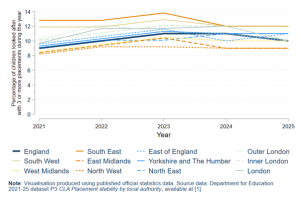
Figure 1. Placement instability over time, by region
This raises an important question. If we know that placement instability is associated with poorer outcomes, and we can see that levels of high placement instability have remained stubbornly persistent, do we need to know more about what lies behind the numbers?
What could our national statistics better tell us?
The existing statistics are essential for monitoring the care system. But there are several ways in which child-level administrative data could help us understand stability in more depth.
First, these annual statistics are essentially snapshots. Even when tracked over several years, they do not necessarily show the shape, duration or meaning of a child’s journey through care.
We need to understand the sequence and timing of changes, rather than simply counting them within a year. Three placement moves could represent very different experiences: for example, a planned move from an emergency placement to a long-term placement is different from a series of unplanned moves following placement breakdown.
While these statistics are not intended to provide longitudinal analyses, we would like to be able to better understand the relevance of the early stages of a child’s care journey. To do this, we would like to see ‘date of first entry into care’ (or simply a flag against the episode of first ever entry into care) added to the national data set and for analysis of stability in the first 12 months of a child’s care journey to be included in the publicly available statistics (we understand it is collected by local authorities).
Distinguishing planned from unplanned moves is not straightforward, but information about legal status and care planning may help us reconstruct what was intended at different points in a child’s journey.
Second, we could look more closely at which children experience different patterns of change. The national statistics already show important differences by age and reason for entering care. Additional analyses using existing data would enable other patterns to be explored: for example, how placement type, needs and circumstances relate to subsequent changes. Monitoring how stability varies between different types of foster care provision, such as local-authority and independent fostering agencies, would be particularly interesting.
Third, we need to understand what happens across different domains of stability at the same time. Placement, school and social worker changes may interact, while other important forms of continuity – such as relationships with family members, carers and other significant adults, or continuity in community and education – may not be adequately captured.
Finally, longitudinal, child-level analysis can provide a different perspective, especially where data from different sources have been linked. For example, the Family Routes study [2] found that, even after a decision had been made that children should remain in long-term foster care, 35% experienced two to four further placement changes and 14% experienced five or more. Children experiencing more placement changes also had significantly lower educational attainment. These findings underline the importance of looking beyond annual counts to understand how trajectories develop over time.
Understanding how to enhance care stability – the Hadley Research Initiative
Better statistics are important, but data alone cannot tell us what stability means to children and the adults who care for them. We need to understand the continuity children experience in their relationships, living arrangements, education and wider lives, and how these different forms of continuity interact. We also need to understand what happens when circumstances change.
A child’s journey through care may involve entry to care, an initial placement, assessment and care planning, matching, permanence decisions and eventually arrival in a more enduring placement. The pathway does not always proceed as planned. Circumstances and needs change; relationships develop; difficulties emerge; and decisions may need to be revisited.
These questions are at the heart of the Rees Centre’s new Enhancing Care Stability: the Hadley Research Initiative. The research will explore what stability means for children in care, how it is established and maintained, why circumstances change, and how different forms of continuity and change shape children’s experiences over time.
Our initial study will bring together research evidence, local authority data, professional knowledge and the experiences of children, young people and foster carers, starting with exploratory case studies in one or more contrasting local authorities. We are particularly interested in understanding the different pathways children may experience through care, including how stability is established following entry to care and how it is subsequently maintained, disrupted or restored.
You can find out more about the research initiative and our plans on the Rees Centre project page.
The aim is not simply to develop better measures of instability, though we will explore the scope to improve how local authorities use and understand their own data. Ultimately, we want to contribute to evidence that can help practitioners, services and policymakers understand, support and enhance stability – recognising that stability is not simply the absence of change, but something that is developed and sustained over time.
How you can get involved
Improving stability cannot be achieved by researchers alone. We want the Hadley Research Initiative to be a shared endeavour involving children and young people with experience of care, foster carers, social workers and other practitioners, local and national policymakers, providers, advocacy organisations and researchers.
We will continue to publish blogs, including on further analysis of existing DfE data. Our next blog will cover whether different domains of high instability cluster within local authorities, whether those patterns relate to known characteristics of local care systems, and whether similar areas experience the same or different patterns of instability.
If you would like to contribute to the Initiative, share relevant research or practice evidence, or explore opportunities to collaborate, please get in touch with the Rees Centre via projects.reescentre@education.ox.ac.uk. You can also sign up to the Rees Centre newsletter here.
References
[1] Department for Education (April 2026) Official Statistics: Stability measures for children looked after in England: 2025,
[2] Selwyn, J. (March 2026) Family Routes: the educational outcomes for children in long-term foster care. Research Report, UK Department for Education (ISBN 978-1-83870-768-2, RR1610). https://www.gov.uk/government/publications/family-routes-educational-outcomes-for-children-in-long-term-foster-care
Written by Ludivine Garside
Latest
-
 BlogAchieving and thriving through belongingSeptember 24, 2026
 -
 BlogUnderstanding children and families through linked data: Opportunities and evidenceJune 19, 2026
 -
 BlogSeeing the whole system: Data, evidence and trust in family justice by Professor Karen BroadhurstMay 28, 2026