





The Project
While research professionals (RPs) play vital roles in the research ecosystem, research which focuses on the career pathways, cultures, experiences and development of research professionals is currently insufficient. Studies are often small-scale, fragmented, under-resourced, or lack the connectedness with policy and practice to make positive contributions and developments across the sector (Caldwell, 2022, Pilgrim-Brown, 2024). Few research projects which involve research professionals look beyond the immediacy of primary institutions, while research professionals are often considered as ‘adjacent’ to other stakeholders, rather than being the focus of research themselves. As such, developments to the profession and the professionalisation of RP careers have largely been dependent on how they collaborate or relate to other people in the academy. Although they may be considered within the wider concepts such as ‘research and development’ or ‘research culture’, RPs are rarely prioritised or respected as professional groups in academic research, in their own right. Furthermore, academic research groups, associations, consultancies and research professional organisations have rarely cross-pollinated with one another in this space, and never on a systematic level in the UK. Thus, research and policy development within research professional careers is yet to have the longitudinal, all-encompassing or sector-wide impact that is necessary for the progression of the profession.
The Research Professional Futures (RPF) project is a four-year £4.5 million national initiative supported by Research England’s RED Fund. The project aims to transform and shape how research is delivered in the UK. It will do so by focusing predominantly on the workforce of research professional staff in UK higher education. The programme launched in January 2026 and is led by a collaborative team from Teesside University, Durham University, Imperial College London and the University of Warwick, with partners from the University of Oxford, Research Consulting, ARMA and PRISM. The empirical qualitative and quantitative research components are being delivered by the research-on-research team (led by Professor Alis Oancea at the Department of Education, University of Oxford) in collaboration with Research Consulting.
The Research Professional Futures project aims to reshape how research is delivered in the UK by focusing on research professionals – specialist professional staff who play a critical but often underutilised role in research success. Working outside academic and technical roles, RPs bring essential expertise that ensures research is delivered effectively, robustly, and ethically. The RPF project seeks to improve efficiency across the landscape of UK HE, fostering a more collaborative research culture through the development of a sector-wide workforce blueprint. The Department’s research-on-research team, led by Professor Alis Oancea, in collaboration with specialist consultancy firm Research Consulting, will deliver the research components of the Research Professional Futures (RPF) project. The team will provide the evidence base for change by analysing the current landscape of research professional roles, identifying future needs, and informing the sector’s first unifying framework of skills, behaviours, and career pathways. The project will involve more than 750 participants and 75 organisations through interviews, surveys, and focus groups. Findings will support institutions to develop and sustain skilled, motivated, and future-ready research professional communities.
The work began in January 2026, running for four years until December 2029. Its impact will continue through an open-access digital platform and a national community of practice to sustain meaningful change.

Additional Information
RPF will be delivered through four interconnected work packages (WPs):
WP1: Context
WP1 is focused on better understanding the current RP landscape through a range of different mechanisms. In this WP, the Oxford team will run a systematic literature review to consolidate previous research. They will also conduct interviews, focus groups, and a Delphi survey with RPs across career stages and career pathways. The team will further provide research assistance on qualitative elements of a nation-wide survey (led by Research Consulting).
WP2: Competencies
WP2 will work towards creating a sector-wide Professional Development Framework and recruitment toolkit. Here, the Oxford team will conduct a second literature review, design a series of co-production workshops and contribute to the development of a sector-wide toolkit.
WP3: Concepts
In WP3, the project will focus on the piloting of institutional and regional initiatives, including shared services and AI tools. The Oxford team will contribute to this WP by undertaking a series of site observations with case study institutions and provide further research assistance to other aspects of the WP, such as regional sandpits and designing evaluation mechanisms for the other pilot activities.
WP4: Culture
The fourth WP of this project aims to co-create a strategic ‘RP Blueprint’, to embed sustainable change. In this WP, the Oxford team will support the development of case studies by designing tools to collect evidence and supporting data collection. The team will work with Research Consulting to integrate the insights from the qualitative and quantitative data collected across the entire project. Finally, the Oxford team will develop creative content, journal articles and present findings from the project at external conferences; engaging with and supporting the dissemination of project guidelines, frameworks, findings and outputs.
Research Team



External Team
More News
-
 NewsCentre for Global Higher Education director on what to expect at the 11th Annual Conference 2026December 18, 2025
 -
 NewsSimon Marginson shares his highlights at CGHE as he steps down as Director in MayMay 24, 2024
 -
 NewsThe Centre for Global Higher Education awarded ESRC legacy centre funding for 5 yearsMarch 4, 2024
 -
 NewsYour input matters. Participate in our communication feedback survey!February 5, 2024
 -
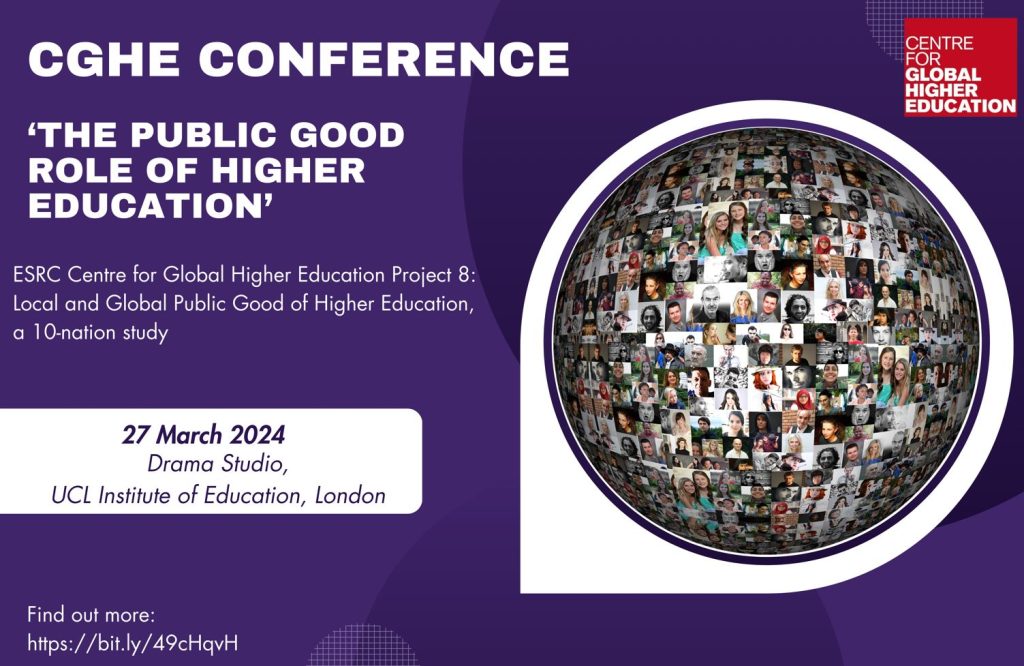 NewsJoin us for CGHE Conference on ‘The public good role of higher education’January 30, 2024
 -
 NewsProfessor Simon Marginson elected a Fellow of the British AcademyJuly 21, 2023