
Be brave, be bold: Kathy Sylva on following curiosity and teamwork

When Kathy Sylva was a doctoral student at Harvard, she noticed a problem that had nothing to do with her PhD.
A fellow doctoral student and friend had two young children but no childcare. So Kathy, who did not have children at this time, suggested they do something about it.
The solution was ambitious: “We have to start a childcare centre,” she remembers thinking.
So they did.
With no university childcare available, the pair raised money, secured space in the basement of the university church – a room normally used for Sunday school and set about creating a parent cooperative childcare centre.
The centre was soon oversubscribed. And when staff were ill, Kathy stepped in herself, working across the baby, toddler and preschool rooms.
“Since I was ‘only’ doing a thesis, I became the (unpaid) supply teacher.”
It was an experience that would shape the direction of her career.
“I saw how early childhood education supported the child’s development in a profound way that’s fun,” she says. “It can’t be boring. It has to be fun.”
At the time, Kathy was studying psychology at Harvard, where she completed her BA, MA and PhD. Her doctoral research involved two experiments with preschool children that investigated the contribution of both play and instruction to problem-solving.
But as she wrote up her thesis, she began to question the very way she had been studying it.
For her experiments, she recruited children in local day care centres and took the children to a quiet parents’ room away from their classrooms and peers. There, she presented them with specially designed equipment and observed how they approached a construction problem after different prior experiences.
The research was carefully designed and she found that prior play led to more effective problem solving than instruction. However, she felt she was ‘seeing the power of play in a very feint light’. Something didn’t sit right.
“I was taking them away from their spontaneous learning in their natural playing environment,” she says, “and offering them a rather bloodless problem to solve.”
She began to wonder what she would learn if, instead of removing children from their everyday environment, she simply watched how they learned naturally in the nursery.
That question became the starting point for the next stage of her career.
This is where Kathy set up her parent cooperative childcare centre. Today, the site is home to The Harvard Yard Childcare Centre. Image credit: Harvard Yard Child Care Centre
From the laboratory to the classroom
After publishing the findings from her thesis, Kathy received a U.S. National Institute of Health post-doctoral fellowship to pursue research on children’s development in Oxford’s Department of Experimental Psychology. During the three years of her post doc, Kathy’s methodological approach shifted almost 180 degrees.
Instead of experiments, she observed. Instead of taking children away from their peers, she watched them playing and learning alongside their friends and teachers. Instead of imposing a carefully controlled environment, she wanted to understand children’s learning inside the natural setting of early childhood education.
Over the course of a year, she and her colleagues developed a systematic approach to observing and assessing challenge in learning. The team observed 120 children in a range of nurseries to identify ‘enabling conditions’ for cognitive challenge. The conditions included interacting with peers, engaging with structured materials like puzzles and – but only rarely – being guided by adults.
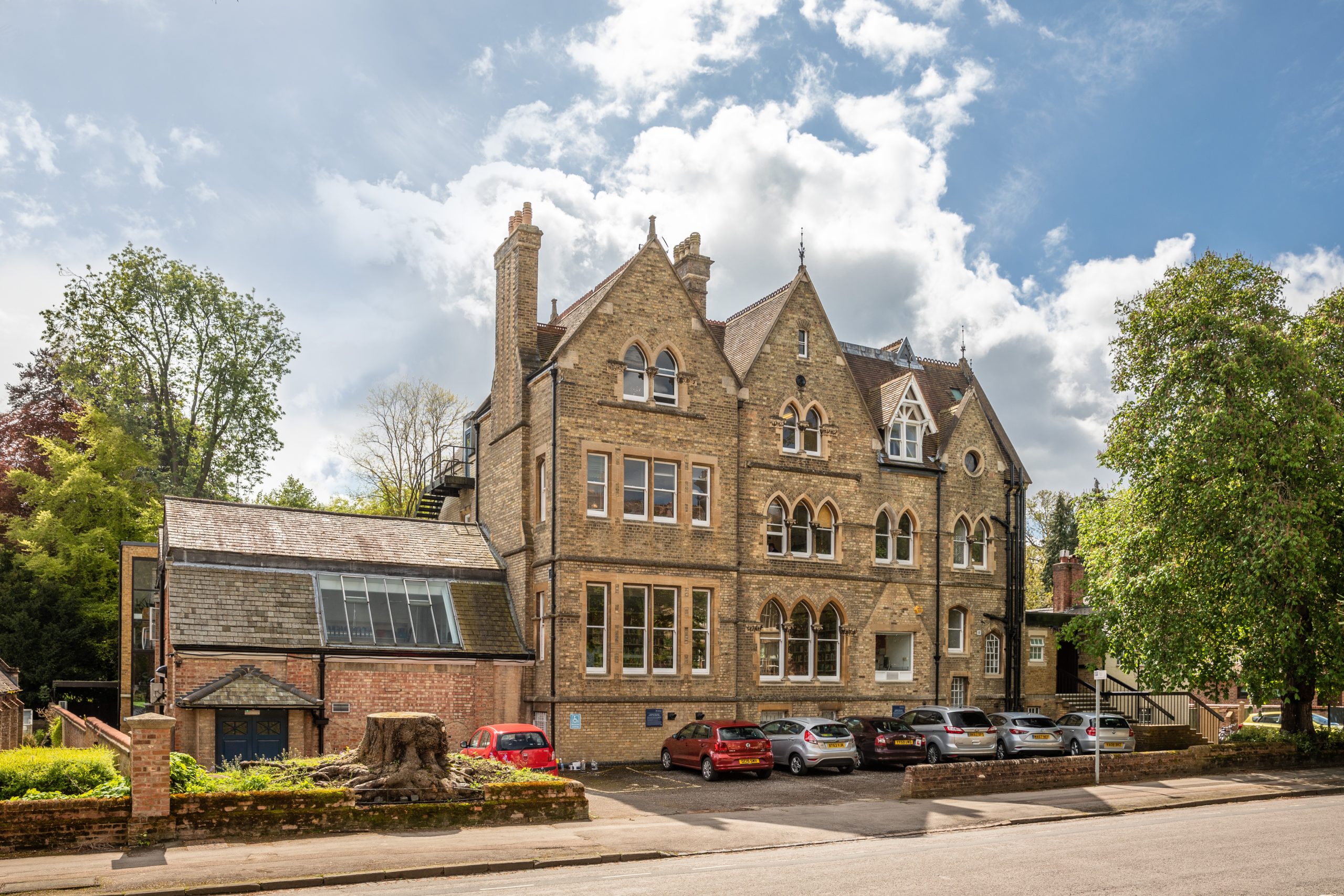
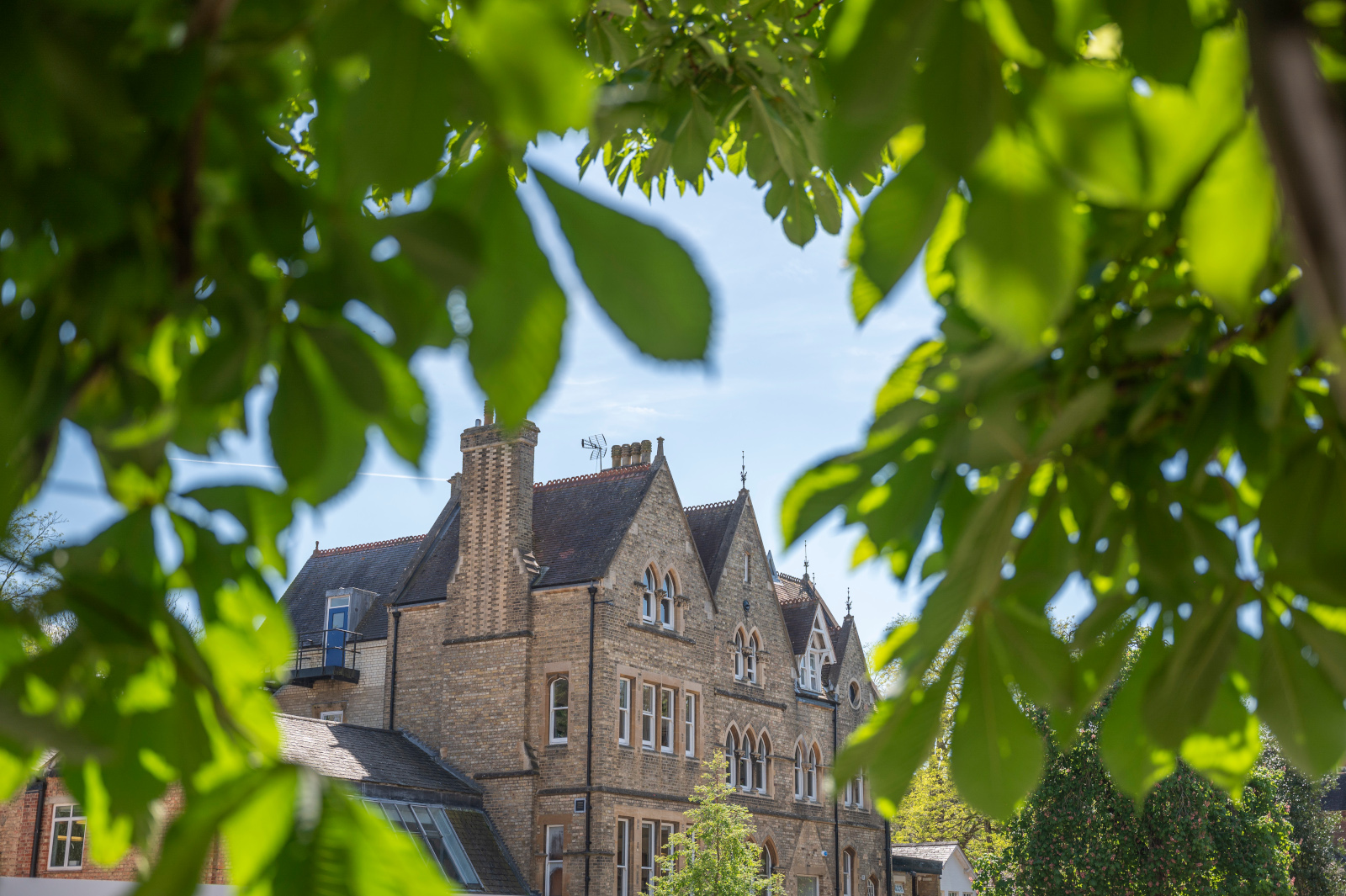
The result was her first book, Child Watching at Playgroup and Nursery School, produced as part of the Oxford Preschool Research Group, led by Professor Jerome Bruner from the second floor of what is now the Bruner Building. Kathy questioned the dominant pedagogy of the time. ‘Unbridled play will not lead to effective learning; the best diet is a blend of guided and free play.’
The experience also changed her understanding of what it meant to do good research.
Kathy had been trained as an experimental psychologist. But when she began studying children in educational settings, she realised that psychologists did not have all the knowledge or methods they needed.
The answer was to work with the educators who brought fresh insights into ways to study learning.
Teachers and playgroup leaders were appointed as members of the research team, working alongside post docs like Kathy to develop structured methods for studying children’s learning in preschool.
“We just worked together as a team to develop the observational methods. We didn’t call it ‘co-construction’ in those days but we were already co-producing our research questions and methods.”
The terminology may have changed, but the principle has remained central to Kathy’s work.
When she designs a research study or develops a new research instrument, she continues to work with teachers – sharing ideas with them and asking for their own ‘take’ on what prompted a learning episode.
Researchers bring one kind of expertise. Teachers bring another.
“We have complementary knowledge,” she says.
“Their knowledge stemmed from working with children every day. Ours came from experiments as in my thesis but also longitudinal studies and systematic observation. Together we designed new methods for studying learning.”
For Kathy, that approach also challenges the idea of the lone researcher working in isolation.
Her own career has increasingly involved teams bringing together different kinds of expertise, including qualitative and quantitative methods.
“Mixed methods is really a team sport. It’s hard for a single researcher to be top-of-the-game in both.”
Learning to be brave
There is another lesson from her early career that Kathy has carried with her: the importance of trying something new and pushing the boundaries.
At Harvard, she recalls, she was encouraged to pursue new approaches and even invent new research methods when necessary.
That did not mean everything would work.
And that, Kathy argues, is precisely the point.
The important thing, she says, is having a team around you when those ideas don’t work out.
Bruner had given her that confidence. If an experiment went wrong, she remembers him telling her, they would find another way forward – even finding extra funding if necessary.
“He really encouraged people to be brave, to set your sights and then push a little further.”
Through this experience, she has tried to pass that same encouragement on to her own students.
“If things don’t go right, there are always ways you can repair.”
Perhaps the most memorable example came when Kathy herself encountered one of the inevitable setbacks of academic life.
Halfway through her doctorate, a conference abstract she had submitted was rejected. To Kathy, then an inexperienced doctoral student, it felt devastating.
She went to a senior professor at Harvard to tell him she had been rejected and admitted that she was wondering whether she was good enough to continue.
He listened.
Then he walked over to a filing cabinet.
Kathy assumed he was about to retrieve some official procedure for dealing with rejected papers. Instead, he took out a bottle of whisky and two glasses.
“He said – we’re both going to have a drink. We’re going to be cross that you got rejected. And then we’re going to think about where you should send it next.”
It became, in Kathy’s telling, a rather unusual academic support procedure.
But the message stayed with her.
Rejection was not the end of the story. It was something to acknowledge, learn from and move beyond.
Years later, she still uses the story to explain what it means to create an environment in which people can be brave.
“As you’re pushing at the boundaries, your stomach is churning and you feel unsure. But if you’re a member of a strong team, when something goes wrong, somebody will get the whisky from the bottom of the drawer and say, what is the next step to push forward?”
For Kathy, bravery is not about pretending failure doesn’t matter. It is about knowing that failure does not have to be final.

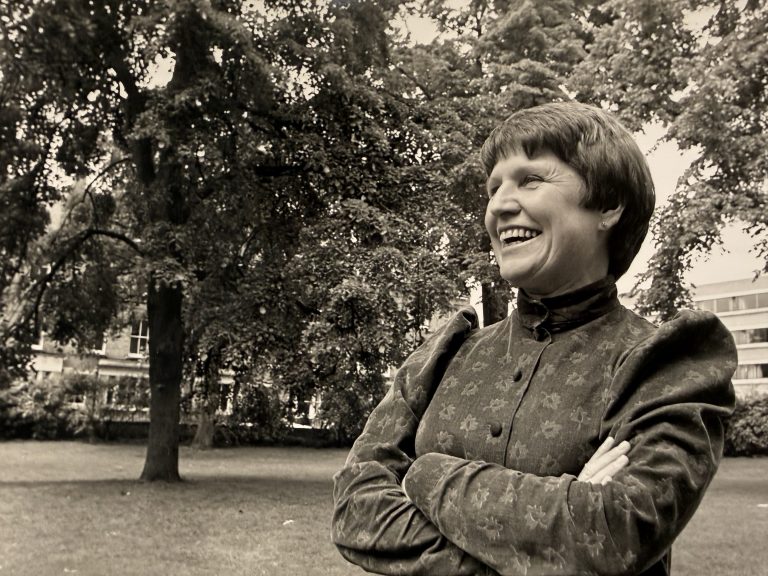
Kathy in PhD robes at Oxford Brookes University, where she received an honorary doctorate.
A career shaped by curiosity
That willingness to question established approaches has remained a constant throughout Kathy’s career. She began by questioning the value of ‘unbridled’ free play but finds herself now defending the power of free play.
After her Oxford postdoctoral research, Kathy taught in social policy before becoming a professor in education at Warwick and UCL, eventually returning to Oxford’s Department of Education as its second professor in 1997.
But titles and status have never been the main attraction.
“What interests me is studying the ways that families and nurseries shape the development of young children. Can we use this knowledge to improve teaching and even the ways we parent?”
Her work has focused particularly on children under six, including children who are failing to thrive, and on understanding what nurtures children’s development – from relationships and families to education and wider services.
For Kathy, one of the most important developments in the field has been a growing recognition that children’s learning cannot be understood without understanding their relationships with carers.
Where pedagogy was once understood through curriculum and instructional techniques, the emergence of relational pedagogy is a significant shift, although new research is needed to tighten the construct.
“When we understand it better, a monumental shift will allow us to reimagine how we teach.”
Today, Kathy is working on strategies to support children’s language development, continuing a career that began, in part, with a simple question: what’s the best way to support thinking and learning?
It is a question that has taken her from a Harvard basement to Oxford classrooms, from experimental apparatus to children’s natural play, and from psychology into education.
And perhaps the thread running through it all is the same one she now offers to the next generation of researchers.
Be curious. Work with others. Don’t be afraid to think outside the box.
And if it goes wrong, there may just be a bottle of whisky in the bottom drawer.
Latest
-
 NewsResearch project to inform policy on the responsible use of children’s data in AIOctober 26, 2026
 -
 NewsAnnual Poster Conference: students and staff showcase researchOctober 22, 2026
 -
 BlogTogether for Developmental Language DisorderOctober 13, 2026