
Finding hope in the field: Isobel’s journey from development to climate education

On a cold morning in rural Bangladesh, standing among fields shaped not just by farmers, but also flooding from unprecedented rainfall, Isobel Talks began to rethink everything she thought she knew.
She had arrived there as a doctoral researcher, focused on girls’ education and the promise of technology in low-income settings. Like many in international development, she had heard the same refrain; that digital tools could bridge gaps, expand access and solve systemic inequalities. But the conversations she was having with young women told a different story.
“They weren’t talking about apps or devices,” she reflects. “They were talking about food, about flooding, about whether their homes would still be standing after the next storm.”
That disconnect between global narratives and lived realities became a turning point. It didn’t just reshape her research. It redirected her entire career.
From geography to global questions
Isobel’s academic path began with studying geography, where she developed an early interest in international development. A Master’s soon followed, focusing on gender and development, before she moved into the sector itself, working with various organisations.
But something was missing.
“I really enjoyed the work,” she says, “but I missed the research side – the space to think more deeply about the issues.”
That pull led her to the Department of Education in 2017 to begin her DPhil. Initially, her work centred on education, gender and technology. But the seeds of a broader shift had already been planted.
A shift in perspective
Her fieldwork in Bangladesh brought the environmental crisis facing us all into sharp focus.
In rural communities, climate wasn’t an abstract concept. It was immediate and personal. Crops failed. Homes flooded. Futures felt uncertain.
One visit in particular stayed with her; a community-led project where women were developing climate-resilient farming practices.
“What moved me most was how generously these women shared their knowledge – practices rooted in generations of careful attention to land, soil and seasons. They were feeding their communities and adapting to a climate crisis they had done almost nothing to cause, using agroecological approaches that industrial agriculture has spent decades dismissing.
“It made me angry, honestly – that the communities doing the most important and ingenious work are so rarely the ones with resources or power.
“What they needed wasn’t another development intervention designed elsewhere.
“It was recognition, support and for people in positions of power to actually listen.”
That experience sparked a lasting interest in environmental education, particularly around food and farming.
Isobel went on to volunteer on a regenerative farm during lockdown whilst writing up her doctoral thesis, an experience that has led to a number of different research projects with the Landworkers’ Alliance and other food and farming organisations – in particular helping to facilitate the Agroecology Research Collaboration.
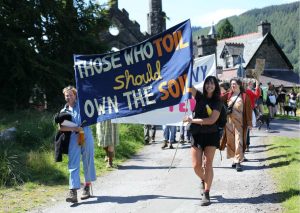
Isobel participated in a land rights demonstration in Scotland, organised by the Landworkers’ Alliance, which she attended as part of her work in education for sustainable farming. Photo by Clem Sandison.
Rethinking education for a changing world
Today, Isobel’s work sits at the intersection of education, the environment and policy. She is a postdoctoral researcher and lecturer in the Department.
Her current focus is the Net Zero Education Project, which explores how climate concepts particularly “net zero” are understood by teachers, students and policymakers across the UK.
The project aims to inform how climate education might be integrated into the curriculum in meaningful, practical ways.
It’s not just theoretical. The project involves visits to schools, conversations with educators and direct engagement with young people.
“It’s been fascinating,” she says. “You see how these big ideas are actually being interpreted in classrooms and sometimes, how unclear or contested they are.”
Alongside her research, Isobel has found a deep passion for teaching, something she didn’t initially see as part of her future.
“I didn’t know if an academic career was even possible,” she admits. “It felt quite unattainable.”
But opportunities emerged. She began co-teaching modules, redesigning courses and supervising students. The experience changed her perspective.
Her teaching often reflects the same themes that run through her research: questions of justice, global inequality and the need to rethink dominant narratives.
Looking outward and around
A recent research visit to Monash University in Australia offered another moment of reflection.
Working with leading scholars in environmental education, such as Professor Alan Reid, Isobel explored how different countries approach net zero and climate learning.
“It was incredibly energising,” she says. “Being in a different context, seeing how others are thinking about these issues. It opens up new possibilities.”
But for all the global travel and policy engagement, some of her most meaningful insights come from closer to home.
She is fascinated with birdwatching, a quiet, attentive practice that mirrors her approach to research.
Her favourite bird, the corn bunting, is relatively rare in the UK, but she discovered during her first few birdwatching trips that it lived in the fields right next to where she grew up in rural Hertfordshire.
“I just hadn’t noticed it before,” Isobel says. “And that really struck me – that there are these incredible things right on our doorstep, if we take the time to look.”
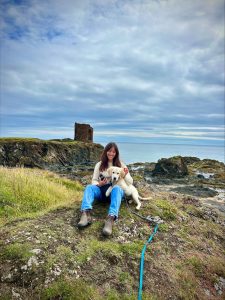
Isobel on one of her hiking trips with her dog.
A different kind of solution
If there’s a thread that runs through Isobel’s journey, it’s a growing scepticism of simple answers.
Technology alone won’t fix education. Policy alone won’t solve climate change and solutions imposed from the outside rarely work.
Instead, her work points toward something more grounded – listening, learning and rethinking what progress looks like.
“It’s about centring the environment in everything we do and recognising that the people closest to the challenges often have the most important insights.”
It’s not a quick fix. But it might be a more honest one.
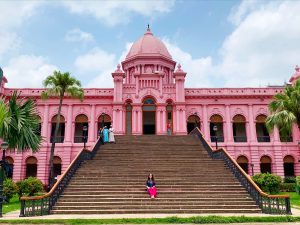
Isobel’s visit to Ahsan Manzil, also known as the Pink Palace in Bangladesh, a vibrant palace which offers a peaceful escape from the busy Buriganga riverfront, a reminder of Bangladesh’s colonial heritage.
Latest
-
 BlogTogether for Developmental Language DisorderOctober 13, 2026
 -
 NewsBritish Academy International Fellowships 2027: Expressions of Interest invitedOctober 12, 2026
 -
 NewsAnnual Report 25/26: Research and teaching highlights of the yearOctober 12, 2026